nari ward at jeffrey deitch projectsby Robert Mahoney
Nari Ward does slice of life art, but at a
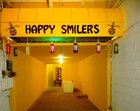
chunk of life scale. His "Happy Smilers"
takes real life and real feelings, and puts
them in an art gallery. A "Happy Smilers"
awning, yellow painted walls, and festive
drink containers welcomes the viewer. Like
any low-cost papaya (or other) shop in the
city, it projects a stereotyped vision of
"local color" or ethnicity. Ward then makes
the gallery itself into the world of the
alley that exists behind the shop. A large
chunk of real fire escape hangs from the
ceiling. Below, a vast barricade of dingy,
weather-beaten, used furniture, all held
together by cut strips of fire hose.
Couches form the foundation, fans, air
conditioners, refrigerators, ironing
boards, radios and other objects the
battlements. From large amplifiers, set on
a tackily carpeted stage, suggestive of
one of those social clubs that
periodically get torched in the city,
tonight's performance seems to be the
sound of rain falling on an air
conditioner. From sound effect, to fire
escape, to the sandy turf of the barricade,
one gets the idea that Ward isvisualizing
not an actual space, but the space which a
thought of "what's going on down there"
from high up in the alley creates, full of
fear, fascination, pity, amazement,
philosophy and charm. The presence of fire
hose interjects the trauma of burned-out
life as well. Fear of new surroundings, of
New York, of homelessness, or fire,
conjures strange "I'm going to end up on
the streets" scenarios, and we mentally
prepare. Thus does real homelessness act
as psychological blueprint or cautionary
tale for emotional displacement on other
social levels. Ward creates this syndrome
with incredible wisdom, power and effect.