Stefan Altenburger
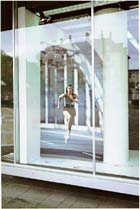
Installation
(Fototafel, Lampe,
Farbe), 1993
Stefan Altenburger
Installation
(Kunststoff-
Netz, Bau gerüst)
1993
Stefan Altenburger
Plastik
(PET-Guss)
1993
Stefan Altenburger
Plastik
(Kartonschachtel,
PVC-Blache)
1993
Stefan Altenburger
Installation
(Zeitungen)
1993
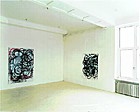
Christopher Wool
Installation view
Christopher Wool
Installation view
 Sherrie Levine
Cathedrals and Hobby
Horses
Markus Lüpertz
Untitled
(Donald Duck Series)
1963
 Markus Lüpertz
Selfportrait
1983
Markus Lüpertz
Männer ohne Frauen -
Parsifal (Men
without women
- Parcifal), 1994
Markus Lüpertz
Krieg
(War), 1992
report from
cologne


by Nina Borgmann


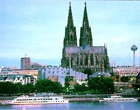
After the longest winter of my life I went

to visit my home town of Cologne. I hadn't

seen my family and my old friends for two

years so it was an emotionally charged

journey. Like most "Kölner," I have a very

strong connection to the town. For us there

is nothing like seeing the "Dom" again

after a long absence. The cathedral sits

on the edge of the river Rhine, blackened

and scarred by the infamous smog of the

"Cologne valley," but with the confidence

of something made for eternity.


I was full of plans and good will to make

the most of my two-week stay. I hoped to

see all of my friends, review the Cologne

art scene, and take care of a lot of boring

business like getting a new passport. My

plans turned out to be much too ambitious,

as my beloved, refreshingly crazy family

took up most of my time. I especially

enjoyed seeing my absolutely lovely

godchild Hannah and all the dogs that are

part of our family. After ten exhilarating

and exhausting days, I decided to relax and

go and see a few galleries and people I

know, abandoning my original plan to

produce an objective, broad report on the

Cologne scene.


To my surprise, every gallery I wanted to

see had moved to a new location, and it

took me a while to get oriented. With my

mind wandering ahead I often turned at

familiar corners only to have to find my

way back through hordes of flaneurs and

shoppers. In Cologne one walks, one does

not run. Finally I arrived at the newest

cluster of galleries, which can be found

above the UFA Palast, a movie theater

specializing in Hollywood blockbusters, set

on a commercial strip complete with Pizza Hut

and American-style sports bars. Despite the

populist environment, the gallery spaces in

this `70s office building are appropriate

for the art of the `90s. (Although somewhat

ironically the stairway exudes the flavor

of dreadful visits to the dentist).


The first dealer to move to this building,

in 1995, was Christian Nagel. He favors

artists who work in what has come to be

called the "institutional critique": Mark

Dion, Andrea Fraser, Christian Philip

Müller and German spiritualist and painter

Michael Krebber, among others. Nagel

formerly headed the most rigidly "group-

dynamic" gallery, working with a fixed

stable of artists; he now declares the

stable gallery to be dead and has decided

to become a "project" agent. The office

spaces above the UFA Palast promise to be

an appropriate setting. Currently on view

is, "A Tale of Two Seas", a collaboration between

Dion and Stefan Dillemuth, formerly known

as the chief executive of the great

Friesenwall 120, a defunct alternative

space. The two collected a variety of

flotsam on the beaches of the Northsea

and Eastsea, catalogued the material

and then presented it on back-to-back shelves

in the gallery with the detritus from

the Eastsea on one side and the Northsea

on the other. The scientific exactness of

the presentation of the pathetic beachcombings

--old rusty metal parts, plastic bottle caps,

 little fish in jars with alcohol, legs of crabs

--created a strange feeling of sadness and loss.

The beautifully labeled, old-fashioned jars

reminded me of childhood visits to the

Natural History Museum as well as

afternoons on the beach happily collecting

seashells, stones or anything the sea had

thrown up. Seeing an account of what really

swims in the oceans these days casts a

shadow over that lost innocence as well as

the romantic science of Natural History.


On the same floor with Nagel, Sabine

Schmidt has opened one of the few Cologne

galleries devoted to photography. She also

organized a big exhibition in Berlin that

presented historical documentary

photographs by August Sander and

Chargesheimer along with young contemporary

artists such as Andreas Gursky, Axel Hütte

and Ute Behrend.


A few flights below, Louis Campagna

inaugurated a 240-square-meter gallery in

March, very loft-like, lit with daylight

from both sides, and with an elegant back

room. He lives in the back, a set-up that

is typical of New Cologne, where everyone

is trying to save money. He even sublet

some of his space to his girlfriend, who is

an independent art consultant. A self-made

man, L.C. opened his first gallery at the

age of 22 in Frankfurt and moved to Cologne

when the `80s heyday was coming to an end.

His opening show at the new gallery

building featured a group of young German

painters, mostly abstract.


Also in the building is Markus Schneider,

proprietor of Lukas and Hoffman Gallery,

who is as concerned with his newly

renovated space as he is with his soon-to-

be-born daughter. Since his ex-partner,

Nikolaus Schaffhausen, left the gallery to

become Germany's youngest player in the

curator's circus (at Künstlerhaus

Stuttgart), Schneider changed not only the

frames of his glasses but also his gallery

program. For the opening show in March,

Swiss artist Stefan Altenburger desperately

tried making sculptures, but all that was

left was a video of his fruitless encounter

with material forces. This tape was

accompanied by a depressing Techno Beat and

projected onto the wall, with the debris

piled up around the space. It transmits

quite believably the frustration and

seeming impossibility of producing

meaningful art these days. In the next room

were photographs from two series called

"Plastic Art" and "Installations." "Plastic

Art" consists of images of discarded

objects Altenburger has found on the

street. "Installations" are photographs of

a found situation, such as a pile of

newspapers, netting around a tree, a little

grass growing at a building, that

Altenburger presents with a caption as his

sculpture. Some of his photographs are

amazingly beautiful, although on the whole

the idea is rather unsatisfying. Which is

maybe intended. I've been waiting for an

artist to notice all the accidental art

that is laying around in the city, that

always seems so seductive. Once again the

old question comes up: what makes an art

piece? I am not so convinced that

Altenburger's photographs cut it.


As a whole I thought that all four of the

galleries had exceptional spaces and that

the atmosphere was relaxed and hopeful. In

a good mood, I walked the five minutes to

the new gallery of Gisela Capitain, a

veteran from the `80s, who also decided to

relocate to Aachnerstrasse, across the

street from an Off-track betting office.

For her inaugural exhibition she selected

New York survivor Christopher Wool. His

East Village esthetics contrasted nicely

with the delicate beauty of the space. The

show was sparsely hung, so you were left

with enough space to muse over the printed,

brushed and sprayed paintings. Capitain's

new lobby also offers a one of the best

walls for paintings of all the new Cologne

galleries. She plans to show Steven Prina,

Larry Clark and Charline von Heyl, and is

also on the look-out for younger artists.

The "Büro Kippenberger" of our dearest

Martin (who by the way just got married on

March 4th, Congratulations!) has also found

a home in her space.


We had a glass of champagne and thus even

more elated I went on to Rafael Jablonka's

gallery. He is another established dealer

who resisted the somewhat mindless trend to

rush to Berlin, instead moving his

operations around the corner to

Lindenstrasse. With his nearly windowless

space, Jablonka seemed to have made a most

disappointing change. His group

presentation of German and American artists

such as Mike Kelly, Julian Schnabel, Hubert

Kiecol and Imi Knoebel was rather

expressionless and vague. His upcoming show

will be work by appropriationist Sherrie

Levine.


A few days later, I visited my idea of the

model space for New Cologne, the Daniel

Bucholz Gallery. He inherited his father's

antique bookstore, which is a book-lover's

dream, and instead of closing it he decided

to open a space behind it for contemporary

art. The coexistence of both these spaces,

especially with the backyard where one can

sit and hang out, makes for a very pleasant

afternoon. He was showing new work by Jutta

Koether, which I missed because the

exhibition gallery was under renovation

when I was there.


Then Easter broke out. In Germany it does

so more violently than in New York.

Everything was closed, and everybody went

on vacation. So on Easter Sunday I went on

a father-daughter trip to Düsseldorf to see

a retrospective of the most German of all

German painters, Markus Lüpertz, at the

Kunstsammlung Nordrhein Westfalen. Happily,

my father and I happily agreed on

everything, above all on our surprise at

Lupertz's success. The show included all

the Lüpertz paintings you never wanted to

see--earthy expressionism goes Dubuffet,

after zooming in on Picasso, along with a

few artistic thefts from contemporaries

like Baselitz and Penck. What began as a

cheerful spoof of Donald Duck in 1963 ends

in the epitome of heroic German legends,

Parsifal.


Back in Cologne, we regained our breath and

visited the Cologne Kunstverein and saw an

installation by a promising young German

artists, Tobias Rehberger. On his way to

Africa he drew from memory some sketches of

modernist chairs by Rietveld, Le Corbusier

and Mies van der Rohe. He left these

drawings with a group of African craftsmen

who were asked to fabricate the furniture

in their traditional manner (preserving the

mistakes and imperfections of his

drawings). Spread around the gallery space,

the resulting chairs were a conceptual

burlesque with a nod to Martin Kippenberger

and a seasoning from Los Angeles-based

artist Jorge Pardo.


Still, Rehberger's exhibition seemed

emblematic of the state of the arts in

Cologne. His work has promising ideas, but

its realization didn't seem to fulfill its

own potential. Despite my positive

impression of the Cologne art scene, it has

not yet regained the strength and vitality

that made the city an art capital in the

`70s and `80s. Also missing is a new

generation of art collectors, who could

easily revive the Cologne scene.


Personally I enjoyed the relaxed atmosphere

immensely and was reminded of the time when

looking at art wasn't linked to stress and

politics. It is a luxury to see a museum

show without 15 elbows poking your ribs,

although it also means the museum is making

less money. I don't understand all the hype

about Berlin as the new art center. Anyway,

who would want to leave a town like Cologne

where every third store is either a

delicious bakery or a friendly bar?