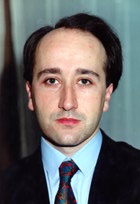
Miguel Angel Cortes
Popular Party's
culture minister
"candidate-to-be"
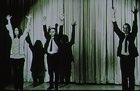
Zaj
"Levantar los brazos"
(raising the arms)
by Walter Marchetti
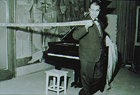
Zaj
"Música para
piano no. 2"
(Music for Piano,
no.2)
by Walter Marchetti
Zaj
"Variations IV"
by John Cage
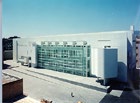
Museu d'Art
Contemporani
de Barcelona
(MACBA)
Guggenheim-
Bilbao project
Architect:
Frank Gehry
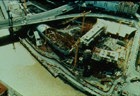
Guggenheim-
Bilbao project
Architect:
Frank Gehry
Guggenheim-
Bilbao project
Architect:
Frank Gehry
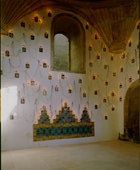
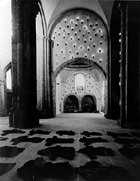
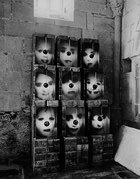
Christian Boltanski
"Advento, 1996"
Christian Boltanski
"Advento," 1996
Christian Boltanski
"Advento," 1996
letter from spain


by Kim Bradley


SOCIALIST OUSTER PROMISES

NEW CULTURAL POLICY

The future of Spain's heavily-subsidized

art world remains uncertain following the

poll-defying Mar. 3 national election.

Pre-election sentiment seemed to signal a

decisive right-wing victory, which would

put an end to the Socialist's 13-year

reign, and along with it the government's

generous arts support. However, the right-

wing Popular Party (PP) candidate, Jose

Maria Aznar, barely squeaked into first

place. In order to be formally granted the

presidency, Aznar is now forced to wrangle

support from antagonistic opposition

leaders who are unlikely to easily forgive

and forget earlier, virulent attacks. Even

the most optimistic observers anticipate

several months of political dickering

before Aznar takes the helm. In the

meantime, the state's cultural institutions

chug along at half steam.


Numerous culture ministry officials and

museum directors have no other option than

to wait to be replaced by the eventual

victors. The PP's cultural platform, which

has been largely concocted by 37-year-old

Miguel Angel Cortes, its culture-minister

"candidate-in-waiting," rests on two main

pillars: educational support and fiscal

incentives. Plans call for the merger of

the culture and education ministries,

purportedly to provide Spaniards with the

well-rounded upbringing they need to

"appreciate the art on view at the Prado,

the Reina Sofia and other Spanish museums."

Under the Socialists, "culture was treated

as a leisure-time activity," complains

Cortes.


In terms of its fiscal measures, there are

widespread fears that the PP will attempt a

Thatcheresque privatization of the arts,

although it couldn't hurt to rewrite

Spain's tepid gift tax law, as the PP vows

to do. The new government intends to boost

private patronage in three main areas:

foundations, restoration of historic

patrimony, and the donation of artworks

(deductions as high as 35% would be

permitted in some cases). In addition,

artists would be allowed to amortize their

income taxes over several years' time.

According to Cortes, "contemporary art

enthusiasts have good reason to be happy

about about our plans."


As one of the PP's few moderates, Cortes is

an anomaly within his own party. Articulate

and energetic, during the past seven years

he kept the Socialist culture ministers on

their toes by bombarding them with

counterproposals in his role as PP's

congressional spokesman for culture. A key

member of Aznar's select five-member think-

tank, he is largely credited with

persuading Aznar of the strategic (e.g.

political) importance of Spanish arts and

humanities. (At one point during the

election campaign, Aznar swore that

cultural programs were second only to

unemployment on his list of priorities.)

However, the Spanish contemporary art

community remains fiercely skeptical. The

cultural policies of other PP leaders, such

as those of Madrid's mayor Jose Maria

Alvarez del Manzano, have proved

disastrous. Alvarez's harebrained schemes

(such as to acquire 15 Botero outdoor

sculptures) frequently provoke angry

protests by Spanish intellectuals and top

gallery dealers (including Soledad Lorenzo

and Juana de Aizpuru).


THRILLS AND SPILLS AT ARCO


Despite pre-election jitters, 160,000

visitors thronged to ARCO, Spain's

contemporary art fair, held in Madrid Feb.

8-14. The record-breaking attendance

represents a 14 percent increase over last

year. Overall, the quality of the work on

view was higher than in recent years.

However, there were few thrills, except for

ARCO's "cutting edge" section, which

included dealers Christopher Grimes

(Santa Monica), Ze Dos Bois (Lisbon),

Uncomfortable Spaces (Chicago), and Carmago

Vilana (Sao Paulo), among others.


The fair's spirited mood masked serious,

behind-the-scenes conflicts which seem

endemic to ARCO. Dealers David Juda and

Hans Mayer resigned from the organizing

committee in disgust, claiming that ARCO's

administrators do nothing to encourage a

market for foreign art in Spain. Portikus

Director Kaspar Konig, co-curator of this

year's "Germany in ARCO," quit a few days

before the fair opened, reportedly due to

ARCO's final-hour refusal to fund a major

component of his carefully-prepared

program.


Although the crowds annoyed some ARCO

dealers, who called for a "more serious"

fair, one had to admit that Madrid's thirst

for art was impressive. Long lines wound

around the Prado to see Velazquez's scary

painting of Pope Innocent X (loaned by the

Doria Pamphili family; now on exhibition at

London's National Gallery through May 19),

and the Reina Sofia's galleries buzzed with

activity. In addition to a huge Balthus

exhibition (through Apr. 1), on view at the

Reina Sofia was the first retrospective of

Zaj (through Mar. 21), a little-known

Fluxus-like conceptual music group that

braved Franco's censors. The show traces

Zaj's entire history, with special emphasis

on its heyday from 1964 to 1973. On display

is an extensive array of photographic

documentation and (the few remaining)

videos of performances, selected recordings

of concerts and sound poetry, and a wide

assortment of Zaj's mail art and

publications. Recent artworks by each of

the three key Zaj members, Juan Hidalgo

(Hildalgo's homoerotic photos merit special

attention), Esther Ferrer, and Walter

Marchetti have also been included in the

exhibition.


Zaj was deeply indebted to John Cage, who

performed with them and helped arrange

their only tour of the U.S. and Canada

(1973). Their relationship with Fluxus was

touchy, according to curator Jose Antonio

Sarmiento. However, both groups relied

heavily on Buddhist Zen thought, and shared

the same influences: Cage, Duchamp, Satie,

Durruti, and Marinetti. As Zaj member Juan

Hidalgo says, the difference between Zaj

and Fluxus is "the difference between the

Marx brothers and Buster Keaton." What

makes Zaj remarkable is its very existence

under Franco; each activity required

official approval. A 240-page Spanish-

edition-only catalogue offers the first

definitive study of Zaj to date.


BARCELONA CONTEMPORARY


The inauguration of Barcelona's long-

awaited contemporary art museum (MACBA),

designed by U.S. architect Richard Meier,

was a major disappointment. The first

sampling of MACBA's collection (on view

through June 6), comprised of 60-odd

paintings and sculptures, is an assortment

of minor works arranged without any

apparent rhyme or reason, and badly lit.

Just to lend an idea: jumbled together in

one segment were works by Anselm Kiefer,

Miguel Angel Campano, Gunter Forg, Jose

Manuel Broto, Gerhard Richter and James

Brown. Even works by talented younger

Spanish artists such as Victoria Civera and

Txomin Badiola, which could have brightened

up the presentation, barely hold their own.


To be fair, it's true that Meier has come

up with a cruelly impractical interior;

there is virtually no classically

proportioned, unobstructed square or

rectangular gallery space in the museum.

But MACBA's most serious problem is a lack

of curatorial imagination. For example,

"Parallel Creations: Metaphors of the

Real," ostensively presented as a major

opening show, was another dreary

hodgepodge. It featured maquettes and

drawings by six artists whose only link was

that of having produced a public artwork in

Barcelona (Claes Oldenburg, Mario Merz,

Jannis Kounellis, Juan Munoz, Jaume Plensa,

and Miquel Navarro).


Fortunately, Barcelona is fairly bursting

with activity. MACBA, rather than setting

the pace, will need to carve a niche for

itself if it doesn't want to be left out.

Aside from the Tapies Foundation's

consistently high-quality programming,

MACBA is also put to shame by the Centre de

Cultura Contemporania de Barcelona (CCCB),

a two-year-old multidisciplinary venue that

has steadily improved its offerings.

Currently on view are "Scenes de la view

future. L'architecture europeen et la

temptation de l'Amerique, 1893-1960"

(through May 14, organized by Montreal's

Center Canadien d'Architecture), which

examines the scope of American

architecture's influence on Europe, and

"Art and Power" (through May 5, organized

by London's Hayward Gallery and Berlin's

Deutsche Historisches Museum), which

presents fascist art and architecture from

Spain, Germany, Italy and Russia. CCCB is

playing a vital role in encouraging local

production of experimental music, film, and

video by hosting international festivals,

which are drawing huge crowds. A slate of

new galleries and alternative spaces

feature emerging art, and a curious

resurgence of performance art seems to be

taking hold. Although so far new local

work is largely derivative, it appears that

(unlike Madrid) Barcelona is on the verge

of consolidating a cultural infrastructure

that could sustain a healthy art scene.


MUNTADAS' NEW INSTALLATION


Among Barcelona's government-run exhibition

halls dedicated to contemporary art, the

one with the best track record so far is

the Centre Santa Monica, which despite its

nebulous identity and second-rate

catalogues has come up with some real

jewels in the last few years, including a

survey of neo-conceptual art in Spain, new

work from China, and little-known

sculptures by Chris Burden.


Currently on view at there is

"Des/aparicions" [dis/appearances] (through

Apr. 15), a large-scale installation by

Antonio Muntadas that addresses the unusual

history of the Centre's 17th-century

building. Before becoming an exhibition

hall, it served as (in the following order)

a convent, a residence for impoverished

artists, home to the Barcelona circus, a

military office-cum-arsenal, a Red Cross

headquarters, a tax collection center and a

journalism school. As Eleanor Heartney has

pointed out, much of Muntadas's work

involves an attempt to reveal the invisible

structure of institutional power.


Muntadas has converted the center's main,

good-sized space into a darkened, makeshift

theater equipped with a movie screen and

seating. Images (some stable, other

intermittent) are projected throughout the

space. The gesticulating hands of local

politicians hover near the ceiling, while

old images of the building fade in and out

on the theatre's walls and floor. In

addition, two videos are shown on the

screen. "S.M.E.P." intersperses segments

of an 1956 propagandistic film about the

journalism school with recent interviews of

its former students conducted by the

artist. "TVE, Primer Intento" is a

chronological compilation of Spanish

national television's official sign-off.

The subtle changes which take place in

these announcements (which depict Spain's

royal family) speak to Spain's democratic

transition. Muntadas has also given new

meaning to the center's lecture hall by

piping in "Hymn of Hymns," a mixture of

national anthems. "The File Room," his

interactive archive of cultural censorship,

is also on view. For more information:

http://www.wsite.es/des-aparicions.


A PLETHORA OF PUBLIC PROJECTS

IN NORTHERN SPAIN


Arts activity is also picking up in other

parts of Spain, thanks in part to new

contemporary art museums.In Bilbao (in

Spain's Basque region, near France), the

new Guggenheim Museum Bilbao, designed by

Frank O. Gehry, is under construction. It

looks beautiful--but when will it open?

Some time in 1997, hopefully.


Meanwhile, the project has drawn the

attention of curators and artists to the

city's gritty industrial landscape. Last

summer, independent curator Corinne

Diserens initiated "Puente de pasaje"

[Bridge of Passage], an ongoing series of

temporary public art projects. So far,

Dennis Adams, Willie Doherty, Marcelo

Exposito and others have been invited to

create works that respond to an unusual

turn-of-the-century hanging bridge (sort of

like a suspended ferry) and/or the

surrounding working-class neighborhood.

Currently scheduled for May is an

installation by Suzanne Lefont involving

large photographic images to be hung in

Bilbao's metropolitan train stations (the

images are designed to be seen by

passengers while the trains are in motion).


In Santiago de Compostela (also in northern

Spain, but on the Atlantic coast side,

above Portugal), the Centro Galego de Arte

Contemporanea (CGAC) has put together an

ambitious program directed toward the

city's primarily university audience.

International artists are asked to produce

new work which is backed-up with a mini-

retrospective, such as in the case of

"Advento," a stunning exhibition of work by

Christian Boltanski. Many well-known

pieces, such as Les Suisses morts,

Monuments: Les enfants de Dijon, and L'ange

de l'alliance, which seem to have lost

their impact (at least for this viewer) in

traditional museum galleries, are empowered

by the special setting employed: the dark,

dank 14th-century Church of San Domingos de

Bonaval (directly adjacent to CGAC). On the

floor of the church, Boltanski has arranged

used coats in a cruciform which echoes the

transept; this a magical piece, impossible

to imagine anywhere else.


KIM BRADLEY is an American art critic

living in Barcelona.