the magazine rack by Patterson Beckwith Art NewsFriezeArt in AmericaFlash ArtArtforum
The April issue of Art News, which my
editor tells me is the only art magazine
that makes a profit, has a two-page ad for
the Lincoln Continental on pages 17-18, an
ad for a cruise line on page 120, an ad for
a fancy Swiss watch made from "space-age
ceramics" on page 41 and an inflammatory-
conservative rant taken out as
advertising by art dealer Louis K. Meisel
on page 38, in which he applauds Ayn Rand
and George Will and demonizes New York
Times critic Roberta Smith for reviewing
art involving "used tampons and sanitary
napkins!", saying that "in the name of
multiculturalism...we are coerced to
dispose of the word `quality'...."
The magazine's gossip section, called "Art
Talk," begins with an interesting two-
paragraph story about how the price is
going up on the most expensive hot-dog-cart
license in New York, the one reserving a
spot outside the Metropolitan Museum of
Art. "This year the Parks Department
doubled the price of the contract, to
$288,200." On the second page, we learn
that Cindy Sherman's first movie, which
went into production in Manhattan last
month, should be released in the fall or
winter. They say that "the film deals with
a serial killer who stalks office
buildings."
On page 110, there is a three-page review
by Kay Larson of the "Total Risk, Freedom,
Discipline" abstract painting show at the
Guggenheim Museum. Larson says that
"Modernism was the century's abstract
sacrament" and goes on to describe what she
calls a "worshipful exhibition" of
non-figurative art. She writes about
walking up the ramp at the museum: "around
you go, rising through the sacred space of
modernism's aspirations. The path is lined
with icons...a parade of spiritually
instructive objects." Her main complaints
are that the show doesn't include anything
by young artists, or anything by Picasso,
and that "the abstract-figurative debate
itself is antiquated."
On page 114 is the cover story, "John
McEnroe: From Center Court to SoHo," a
congenial interview with McEnroe by Art
News publisher Milton Esterow. The
priceless cover photo, taken at the tennis
star's art gallery, shows a balding and
goateed McEnroe sitting at his desk in
front of a giant red-and-white Ed Ruscha
painting that says AN INVASION OF PRIVACY.
The article paints McEnroe as a charming
dilettante of an art dealer. He says things
like "I'm a little uncomfortable to say to
someone `hey, buy this, buy that.'" and "I
still feel like I have a lot to learn. One
of the best things about having a gallery
is learning. I'm light years behind those
sharks out there." The article is peppered
with complimentary quotes from Laurence
Salander and Eric Fischl. Salander runs an
art gallery where he let McEnroe
`apprentice' for a few months in 1993,
before John opened the John McEnroe Gallery
in 1994. Salander says that "He's set up
emotionally and intellectually to love
art...he's intelligent and sensitive enough
to understand art and to need it." And from
Fischl, "I think he's extraordinary. What
impressed me was how fast he put together a
consistent collection. We've gone to
galleries, and I've watched him pick out
the best drawings." Fischl also says that
he and John traded drawing lessons for
tennis lessons a few years ago, but that
McEnroe was hopeless as an artist.
The story seems to be that McEnroe was an
art collector and museum-goer throughout
his tennis career, and increasingly since
he retired five years ago. He had lots of
friends in the art world, mostly dealers,
who wanted to encourage his interest in
art. He bought a loft at 41 Greene Street
to live in and then on a sort of lark
decided to have an art gallery instead. It
seems like he is in the resale business,
borrowing artwork from other galleries. He
has an assistant, Steven Soulios, who says
in the article, "I see myself as a curator.
We hope to push forth new ideas. You can
still be avant-garde with figurative work.
That's the vision we're trying to show."
Still, though, McEnroe seems to aspire to
representing artists on his own: "I've
heard from some of the guys like [the
dealer] Bill Aquavella that I should just
deal with the dead guys, because dead guys
are a lot easier to deal with. Still, in my
heart I want to be someone who can find a
niche with some younger artists. I'd like
to be part of bringing an artist up from
obscurity. Obviously, the artist has to be
good--that's the main thing."
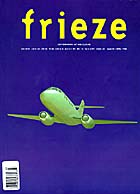
In Frieze, the British art magazine, there
is a short piece titled "Angelic Upstarts"
about the new art school in Italy called
Fabrica run by the Benetton clothes
company. Author Jeremy Millar left the
school feeling really disillusioned with
the place. His complaints, first about the
institution and then about Oliviero
Toscani, Benetton's ad-man and founder of
the school, are cutting and insightful. He
mentions that the school's reflecting pools
were poisoned with fungicide to discourage
gypsies from using the water, and then goes
on to talk about Toscani: "During my time
at Fabrica, the French resumed nuclear
testing in the Pacific. The next day,
Oliveiro had the front page of Liberation:
Chirac's face disfigured with badly
photoshopped keloid scars. The day after,
it was this image that became the news, on
the front of all the other newspapers,
effectively replacing the issue which it
had sought to raise." Continuing, he
alludes to the internal politics of the
institution, which opened less than a year
ago. Sounds like high turnover.
On page 48, there is a four-page piece by
Stuart Morgan about the painter John
Currin. Accompanied by five reproductions
of Currin's work, the article speculates as
to why the paintings seem to show such
disregard for their (aging, nude, mostly
female) subjects. Morgan guesses: "Perhaps
loathing of the human body...forced Currin
to assume the role of satirist. Satirists
tend to be old-fashioned, intent on
resisting change." Describing a painting of
a woman called Guitar Lesson, Morgan says
that "The result is embarrassing but also
infuriating: a low trick played on us as
well as her. But also on women in general."
Towards the end of the piece, Morgan quotes
Currin, who says his work is "Realist
drag," and says that "the paintings take as
their subject matter human relations at
their most abject...the final effect is
destructive, grotesque, nihilistic."
On page 58, Juan Vincente Aliaga pans the
exhibition "Femininmasculin, Le sexe de l'art"
at the Pompidou Center in Paris, saying
that the show was "short-sighted and
prudish" and that "the curators linked
themselves more closely with the fantasies
of the '70s than to...more recent art."
Aliagas objected to the "almost exclusively
white heterosexual orientation of the
show," which he says "undervalued the
impact of AIDS on art." The review
expressed dismay that curators from the
land of Foucault could totally "ignore the
cultural and behavioral ramifications of
behavior and sexuality" in favor of an
"appeal to nature." He aimed his strongest
criticism at one section of the show
devoted to the reproductive process,
remarking that "Feminist struggles to
separate sexuality from procreation seem to
have served no purpose."
"Small Talk" by Kate Bush on Joseph Grigely
appears on page 64. "Grigely has been
totally deaf since childhood," explains
Bush, "The substance of his work is the
dialogues he has with others in the form of
notes scribbled on pieces of paper." The
artworks, called "Conversations with the
Hearing," are occasionally presented as
installations representing the place where
the conversations "have, may or will
occur," like a studio or restaurant.
Grigely has also made a book, called Deaf
and Dumb: A Tale, which Bush describes as
"a pseudo-anthology of documents relating
to the history of deaf education." It is
the "Conversations," which she quotes
Grigely as calling "drawings of speech,"
which are the subject of the article.
Writing that the work is "an emblem for the
impossible pursuit of meaning," and also
that "it is unsurprising that [it] has been
likened to the urgent calligraphies of Cy
Twombly," she says that Grigely has
bettered other artists who "have tried to
counter the muteness of the art object
through direct methods of communication,"
the difference in his work being that it is
not just a one-sided declaration, but
rather an examination of an exchange.
In the reviews section at the back of the
magazine, Ronald Jones writes about the
"Haute Couture" show at the Metropolitan
Museum. Jones says that the show "is not
only a beautiful exhibition but historically
profound in ways at least as engaging as
anything on the museum's upper floors."
Emphasizing the "seriousness" of the
exhibition, he writes about what he calls
the political clout of the fashion designer:
"Consider how the [recent] use of fake fur
has foregrounded the agenda of the animal
rights and anti-fur movements. Couturiers
can make `artists,' who think they have
been truthful, feel awfully jealous."
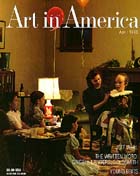
Art in America's news section, called
"Front Page," has a short article about a
group show in Stockholm called
"Interpol." The story is about the opening
of the show, where a Russian artist named
Alexander Brener, "declaring that he had
given up art to become a rock star, started
to bang away on a drum kit. In the midst of
his performance, he rose from the drums and
began destroying a large installation work
[made mostly from human hair] by one of the
other artists in the show, Wenda Gu."
Another Russian artist, Oleg Kulik, was
arrested for injuring people at the opening
during his performance art: "Naked and
chained to a doghouse, Kulik imitated a
vicious dog, attacking anyone who came
within range."
In a five-page "Report from Korea," Eleanor
Heartney describes a big new international
show there called the Kwangju Biennale. It
seems like Heartney had a bad time in
Korea; she bellyaches about "confusion
caused by the scarcity of multilingual
guides...lack of adequate transportation...
[and] the unavailability of catalogues and
press materials," saying that "visitors
plunged into the opening chaos might be
forgiven for thinking that Kwangju was
not quite ready for primetime." She goes
on to say that the works in the main show
of the Biennale, called "Beyond the
Borders," seemed to have been chosen to
"emphasize the enduring cultural traditions
of artists' native countries," and that the
choice of the Cuban artist Kcho for the
$50,000 grand prize "Underlined the
preference for homespun, socially conscious
commentary." Kcho's installation, entitled
"Para Olvidar," "featured an old rowboat
resting atop a field of upright beer
bottles."
The cover story, about Canadian artist Jeff
Wall, is a review of a traveling show of
the artist's recent work. Written by Richard
Vine, the article makes Wall seem like a
critic's dream; his pictures lend themselves
to diverse and colorful interpretation, with
which Vine fills most of the article. Vine
also describes in detail Wall's technique for
making his highly constructed photos,
saying that the figures are "blatantly
posed," and the shots "frankly devised." He
says that the lighting "mimics the banal
allover illumination of contemporary film,
TV and advertising." The effect of all
this, he concludes, is that Wall comes to
"embody the...very totalizing power his
pictures teach us to dread."
"Visual Voices" by Raphael Rubinstein is
about three artists who use writing in
their work: Joseph Grigely, Kenneth
Goldsmith and Sean Landers. Rubinstein
seems pissed about having to read Sean
Landers' handwritten, misspelled,
confessional book,Sic, and he calls it
boring and difficult to read. Giving a bad
review to Lander's for his writing is like
shooting fish in a barrel for Rubinstein,
as he reproduces the most self-indicting
confessions from Landers' book: "I mean the
belief or hope in the back of my mind is
that even though this writing appears...trite
and meaningless that somehow it possess a
deeper more profound meaning." Rubinstein
says that "The ultimate problem...is in the
relentlessly circular, solipsistic nature of
Landers' imagination." The section on
Grigely suffers from the lack of firsthand
discussion Kate Bush had in her article
about the same artist in this month's
Frieze (see above). He says of Grigely's
work, "Conversations with the Hearing":
"The subject is not so much the artist's
deafness but the complexities of
language," and applauds Grigely's
"accessible personalization of complex
theoretical issues." Then Rubinstein turns
to condescension, equating Grigely with
Chuck Close (confined some years back to a
wheelchair by a sudden paralyzing illness),
as an unfortunate victim. The piece ends:
"The resourcefulness and grit with which
Grigely responds to his difficult situation
is exemplary." Kenneth Goldsmith's book,
No.111 2.7.93-7.22.95, is a 600-page
collection of original and plagiarized
phrases and words, organized alphabetically
and by number of syllables. Rubinstein
seems to have enjoyed the rhyming nonsense,
and he includes a full column of the text
in his article: "alterna-sucker, always a
pleasure, amateur kisser, Amber Valetta,
ambient sleeper, ambulance chaser, AMC
Pacer." He says that "Goldsmith brings to
the textual tradition of Conceptual art...a
hitherto absent sense of hypnotic beat."
There's an ad for ArtNet on page 110, right
before the back-of-the-magazine reviews.
"Look for our online magazine," it says.
Flash Art's first dozen or so editorial
pages are, as in every issue, made up of
the longest "News" section of any art
magazine. The stories are mostly taken
straight from press releases, and the whole
section is an unreadably boring account of
shows that opened or are going to open at
various museums and art fairs. There is one
short piece, accompanied by a reproduction,
about how the Museum of Modern Art has
purchased a complete set of "Untitled Film
Stills" from Cindy Sherman for about $1
million, and another about how Flash Art's
own "Art Diary" directory is going online.
Jake and Dinos Chapman, who were on the
cover of the last issue of this bimonthly
magazine, have taken out an ad that appears
on page 35. A full-page response to a
review by Martin Maloney, signed by the
brothers, it charges Maloney with having
"an erotically intense interest in his own
opinion" and "an inferiority complex." The
reply ends with the facetious admission
"...we are '80s artists, we are gratuitously
contrived from magazines like an
aesthetically montaged Frankenstein and
we are less than base pleasure." On page
49, there is a less critical review than
the one in Frieze of the "Femininmasculin"
show at the Pompidou. Eric Troncy says that
"everything that depicts a penis, a vulva
and the various orifices has been brought
together under the Centre Pompidou roof for
the occasion." "In the final analysis,"
Troncy allows, "we get to see some very
nice artworks...[but] what "Femininmasculin"
is lacking [is] a stronger rock-and-roll
dimension."
Dike Blair has an article on page 78 called
"Artist's Dream Machines: The Films of
Longo, Salle, and Clark." Blair offers a
plausible explanation for why so many
"films directed by artists, pretty much of
one generation with little or no previous
experience in film-making, all appear at
once," the answer being money. He explains
that the entertainment industry is cashing
in on America's appetite for independent
films; the industry has figured out that
"after all it's just about as easy to make
a knock-off of Pulp Fiction as it is of Die
Hard." He writes that "what Longo, Salle
and Clark have been doing all along in the
art world matches the job description of
the auteur film-maker." Blair passes over
the mediocrity of the artists' movies to
claim that making movies is a legitimate
extension of what Clark, Salle, and Longo
do in galleries. "The main ingredients of
all three films reduce to those of the
artist/director's work. Longo is
preoccupied with scale and media-dynamics.
Salle organizes an amalgam of images that
are simultaneously tasteful, detached and
disturbing. Larry Clark offers up is edgy
adolescent obsession." In a epilogue to the
article, Blair did a short interview, "A
Chat with Cindy Sherman," about her
untitled horror movie. Sherman pitches the
movie, which is being written by someone
else: "It's about this secretary, Doreen,
who lives in Queens. She's a dim-witted,
mousy person who works in an office. She
accidentally kills somebody when she's
working late...this sort of empowers her,
she gets off on it and starts killing more
people in her office. Then she starts
bringing home their bodies, one by one,
back to the basement of her apartment in
Queens. With all the dead bodies she sets
up a sort of 'Sherman' tableaux, a sort of
office that represents her ideal
environment." The article would've
benefited from some discussion of the movie
that Pace gallery owner Arne Glimcher
produced,Just Cause, which was really,
really bad, trite and formulaic. Would he
say it is a reflection of Arne's gallery
career, or what?
On page 88, there is an incoherent and
rambling article by Janine Gordon called
"SM(Art) Alex Videos," about Alex Bag,
Alix Lambert, and Alix Pearlstein. The
piece takes as its premise that "the use of
video as a socially critical medium by
three female artists who happen to share
the same first name is anything but a
coincidence." Gordon then fails to explain
how this is not a coincidence. Gordon
sounds kind of insane when she tries to
explain why video is an important medium:
"Video is used as readily as the printed
word and distributed, reproduced and
transmitted as frequently via Blockbuster
Video, cable satellite, NASA and the World
Wide Web. As soon as the economy picks up,
we will have videos on all our computers
and we will be able to see our
conversations live." She makes even less
sense when she compares the three artists'
work, writing that "challenging or
embracing the redundant banality in
everyday life through theatrical
performances synthesizes and synchronizes
Alex Bag, Alix Lambert and Alix
Pearlstein's videos." She ends the article
by stating that "the mutation of an
individual's so-called sincere or fixed
identity into an abstract notion of
selfhood questions the transparency of
appearances. The knowledge that play-acting
exposes by exaggerating a specific reality,
theatrically unravels a concealed truth."
Whatever....
Artforum more than any of the other art
magazines, seems to aspire to a
general-interest audience. Or maybe they
just want to appeal to their art-audience's
other interests. Its April issue has 11
articles with non-art subjects, compared to
five about art exhibitions or artists (not
including the art reviews in the back of
the magazine). There are two articles about
the Internet, four articles about music,
one article about fashion and four articles
about movies. I am probably just sick of
reading about art from writing this piece,
but I find the non-art stories refreshing
and interesting. On page 15 and 16 are two
articles about computers. The first is a
review of a book by Bill Gates, and the
second, called "Hot List," is a regular
column about Web pages by Mark Van de
Walle, this month devoted to sites about
movies. Other writing about movies includes
a Q&A with participants of the Sundance
Film Festival; J. Hoberman on The
American President, which he says is all
about Michael Douglas being like Bill
Clinton; a Thyrza Nichols Goodeve interview
with The Brothers Quay; and a "Focus"
review in the back of the magazine about an
exhibition of French filmmaker Chris Marker
at the Wexner Center. The music articles
are about--what else--alternative music;
reviews of a new Yoko Ono album, a new
album by the all-girl punk band the
Raincoats, and an article by Charles Aaron
about white-boy blues music (Beck, Railroad
Jerk, the Jon Spencer Blues Explosion).
Further on in the magazine there is a piece
by Jan Fjeld about Brazilian rap music.
Fjeld describes the difficulties faced by
rap artists, whose music goes unplayed on
the radio and whose impoverished audience
mostly has no buying power; "the average
monthly wage is $100; a CD costs around
$20." Fjeld ends the article by saying
that "Brazilian rappers and hip-hop culture
are where North American rappers were in
the mid '80s: struggling to broadcast their
hard-edged social message beyond the
borders of their own neighborhoods."
Artforum has recently exhibited an unseemly
obsession with fashion, but this issue
seems to be an exception; it only has one
article about clothing. French Critic
Olivier Zahm's regular two-page spread,
"Flash Track," consists of his writing
about the work of one fashion photographer
and one fashion designer. This month's is
actually pretty cool: he got 24-year-old
London style magazine photographer Mario
Sorrenti to take pictures of clothes by an
underground NYC clothing and art collective
called the Bernadette Corporation. On page
63, there is an ad taken out by the two-
person collaborative called Liz-n-Val. They
always have an ad; this month's is
relatively low key, only a quarter-page and
in black-and-white. It is a cartoon of
little boats with flags on them that say,
"Seeking Creative supporters...Brave
Patrons, Brave Galleries, Brave Museums,
Critics, Global Savages Adventure." It also
has their phone number and their signature
in the bottom right corner. Liz-n-Val are
just like Dan Graham, making art especially
to go in magazines, with the difference
that I don't think Graham still has to pay
for his space, does he?
Patterson Beckwith is an artist who lives
and works in New York.