the magazine rackby Patterson Beckwith October - November 1996
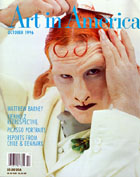
The cover of the October 1996 Art in
America features a picture of the artist
Matthew Barney combing his hair. Inside, on
page 82 is a ten-page article by Barney
scholar and fan Jerry Saltz about Barney's
new short film, Cremaster 4. Saltz lists
Barney's achievements: "At 29, Barney was
the subject of a recent traveling
retrospective; in addition to the 1993
Whitney Biennial he appeared in the 1995
Whitney show; he was in Documenta IX (1992)
and the Aperto section of the 1993 Venice
Biennale, where he won a medal." Saltz says
that "for all of the deserved recognition
that Barney has received, his work has also
acquired an undeserved reputation for being
opaque and impossible to grasp. Barney's
art is not obscure, but it is difficult.
Somewhat mysterious and hermetic, like a
lot of good art, it takes extended
looking."
Saltz has looked extensively, even
obsessively; on the third page of the
article, he mentions that he has watched
the 43-minute Cremaster 4 video more than
75 times. He describes what happens in the
video: "It opens with a shot of a structure
at the end of a very long pier on the Isle
of Man. Inside the building, Barney,
dressed in a white, vaguely Edwardian suit
and sporting bright red hair, begins to tap
dance. Beginning slowly, he dances in one
place and at some length. His dancing
starts to wear away bits of the floor.
Eventually he dances his way through the
floor of the pier and drops into the ocean;
he then proceeds to dig through the sea
bottom, and crawls through a long, narrow,
Vaseline-filled tunnel. This passage
finally leads back to the surface of the
Isle again."
From time to time, the video cuts away from
Barney to a motorcycle race taking place on
the island. Saltz writes that Cremaster 4
"is, I believe, a masterpiece of 1990s
art," and then begins a lengthy section
called "Dissecting Cremaster 4." Saltz
starts by informing his reader that the
cremaster is the muscle that suspends the
testicles and that "men have cremaster
muscles, women do not." Saltz says,
"Barney's video deals with time in various
ways...there are 325 cuts. That is about
7.2 seconds average per scene. It is never
clear how much time actually elapses in the
tape, and this is not just a result of
filmic devices such as slow motion and
speeded-up action. How long does it take to
tap-dance through a plastic floor? On a
more metaphorical level, it is possible to
imagine all the action of the tape
occurring simultaneously, in an instant."
In the next sentence, Saltz writes, "Why
Barney pays all this attention to the
progress or problems of testes moving down
or ovaries moving up becomes clear when you
consider the fetal development cycle."
Saltz says that that it has something to do
with the seventh week in the womb, when the
fetus is still sexually undifferentiated.
But really it doesn't become that clear
why Barney is paying attention and to what.
There is an article by Ken Johnson on page
51 about the Massachusetts Museum of
Contemporary Art in North Adams, Mass.,
that it is going to open in a giant factory
complex in 1998. Johnson also wrote a
sidebar about the museum's first
exhibition, an installation called Desire
created last summer by Talking Head David
Byrne, "an audio-accompanied environment of
illuminated mock-advertisements that skewer
mass-mediated fantasies of fulfillment."
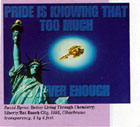
These were big pictures of the Statue of
Liberty, money and handguns accompanied by
slogans like "Pride is knowing that too
much is never enough." Johnson's evaluation
was that Byrne's art is "cartoonish and
didactic" and doesn't cover "any stylistic
or conceptual territory that hasn't been
explored in more revelatory ways by such
artists as Barbara Kruger, Jenny Holzer and
Jeff Koons."
On page 75 there is a full-page ad for a
print by 11-year-old art prodigy Alexandra
Nechita. The print is titled My Torch Shall
Guide Me and is, the ad copy says,
"Inspired By The Athletes Of Special
Olympics," for whom it has "helped raise
$1.5 million." There is a photo of the
artist and a reproduction of the print, a
Picassoesque image of a figure with a
torch. On the next page is a six-page
article about the recent Picasso portrait
exhibition at MOMA called "Picasso and
Portraiture." Carter Ratcliff says that
most of the portraits are of women, and
that "Picasso usually painted a particular
woman, with obsessive attention to whatever
bliss or terror or mixture of the two that
she induced in him as he worked." He
concludes the article by saying, "In one
image after another, Picasso offers a
carefully managed standoff between mystery,
which he understands as essentially female,
and the impulse to order, which he
construes as male."
On page 98, there is a ten-page article by
Reagan Upshaw about the art of Edward
Kienholz. Written on the occasion of the
(just closed) Kienholz retrospective at the
Whitney, the article frames Kienholz as a
sort of politically explicit Rauschenberg.
"Long before the current wave of political
art, Kienholz was creating sculptures that
dealt with specific issues and events. He
took aim at organized religion...the
mistreatment of minorities...[and] the
myths of American history."
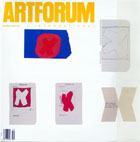
The first thing in October's Artforum is
the Q&A section, the monthly column where
they ask a bunch of artists and writers the
same question. This month's question was
"What's your favorite quote or phrase?" In
the introduction, Thyrza Goodeve quotes
Walter Benjamin: "All writing consists
largely of quotations." John Baldessari
quoted himself, once from a 1971 artwork,
"I will not make any more boring art," and
twice from a lecture he gave in Santa Fe,
"The problem of art is art" and "Beauty is
rearing it's ugly head." Filmmaker Gregg
Bordowitz said his favorite quote is from
Mao: "Criticism is an act of love." The
writer Avitall Ronell quoted Kenny Rogers'
Gambler song, about knowing when to hold
them, when to fold them and when to run.
And the artist Raymond Pettibon gives a
passage from the Bible that he says "sums
up the whole issue of quoting:" "And if any
man shall take away from the words of this
book...God shall take away his part out of
the book of life, and out of the holy city,
and from the things which are written in
this book."
On page 18 is Mark Van De Walle's "Hot
List," a column about Websites. This month
the column is about television, and he
gives the address for "The Ultimate TV Show
List," which he says will point you to
pages for "almost every show ever made, no
matter how obscure."
(http://tvnet.com/UTVL) He also lists the
Institute for Propaganda Analysis, because
"the most important thing to remember about
television is that, regardless of how much
you love it, it doesn't love you back"
(http://carmen.artsci.washington.edu/propag
anda/contents.htm#intro), and the Chomsky
Archive, (http://www.lbbs.org/) for its
"selection of his speeches and papers on
exactly why TV can't be trusted."
Artforum seems to be the only art magazine
that has managed to attract clothing ads;
on page 8 is a full-page taken out by Jil
Sander, and on page 23, facing an ad for a
new Moschino store, is a two-page interview
by Darryl Turner with Interview editor
Ingrid Sischy (who used to edit Artforum)
and Guggenheim Museum curator Germano
Celant. Sischy and Celant were the joint
artistic directors of last summer's Firenze
Biennale, where they organized an
exhibition called "Time and Fashion," which
included collaborations they facilitated
between clothing designers and famous
artists, like Jenny Holzer and Helmut Lang,
Jill Sander and Mario Merz, Gianni Versace
and Roy Lichtenstein, and Damien Hirst and
Miuccia Prada. Sischy says, "So much
contemporary art seems to want to touch or
parody or critique fashion, there are
specific designers who are actually taking
on issues of the body, who aren't being
discussed in that manner in the fashion
world. While fashion editors talk about
black being in or out, or hemlines, or
skirts versus pants, somebody like Jean
Paul Gaultier may not give a damn about all
that." Celant, adds, "In many ways fashion
has to fight against the same prejudices
that photography came up against 100 years
ago. First we had to assert that fashion is
a serious, creative language, which is a
question of representation, right? You
can't do it simply by showing a dress. It
is the same problem as with photography:
How do you get beyond the documentary,
illustrational aspect?"
On page 63 is a full-page ad for the
Merchant-Ivory movie Surviving Picasso
starring Anthony Hopkins. "Only his passion
for women could rival his passion for
painting," it says at the top of the page.
On page 78 there is a quarter-page ad taken
out by the artists Liz-n-Val. It is collage
of two sunbathers with cartoon bubbles
above them. One says, "Is art something,
Val? I've asked patrons, critics, dealers."
The other replies, "Liz, it is absolutely
and positively nothing; it doesn't even pay
for rent."
On page 86 are pieces by six critics about
Ellsworth Kelly, written on the occasion of
his big show at the Guggenheim. There are
musings on the painter by Dore Ashton,
Michael Brenson, Yve-Alain Bois, Jean-
Pierre Criqui, James Meyer and Lisa
Liebmann.
The regular fashion column in Artforum,
"Flash Track," has photos taken backstage
at a Martin Margiela fashion show by Anders
Edstrom and a few paragraphs written by
Olivier Zahm, who says that the seemingly
unstudied photos "mirror Margiela's
penchant for pure forms, for the disruptive
energy that comes from busting up the
conventions of high-gloss glamour."
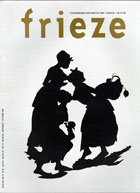
The October Frieze has two articles
analyzing advertising campaigns. The first,
"Young Meat" by Matthew DeBord, is about
McDonald's ads for its new hamburger, the
Arch Deluxe. The burger is meant for grown-
ups, because it has lettuce, tomatoes and a
Dijon mustard sauce, and the ad campaign
makes this point via billboards and
television. The billboards said, "We'll see
you on the other side of childhood" and had
photos showing children "grimacing at the
prospect of having to eat anything other
than beef or sugar." DeBord writes, "Even
the name resonates with nostalgic, elderly
tones: `Arch' recalls the yellow double
arches of the company's original restaurant
outside Chicago, `Deluxe' the deluxe
hamburger option on the menus of coffee
shops that McDonald's has replaced." The TV
spots featured Ronald McDonald, the funny
clown from McDonald's, appearing in grown-
up situations; golfing, dancing at a
discotheque, and shooting pool in a pool
hall. Stating that "McDonald's is, along
with Disney and the U.S. federal
government, one of the world economy's
prime manipulators of children, preying on
the basic contradiction that children come
from sex but are supposed to be asexual
entities", DeBord expresses his concern
that the Arch Deluxe campaign "represents
the trend of wielding images of children
for commercial ends at its most disturbing,
saying that "`we'll meet you on the other
side of childhood' sounds a lot like an
illicit come-on."
On the same page is another advertising
deconstruction piece, by Valerie Steele,
about the Italian clothing company Diesel's
marketing strategy. Steele says that, "the
typical Diesel ad will feature several
young and attractive models who are
juxtaposed with banal, bizarre or
grotesque images, such as `50s style TV
dinners, generals wearing nappies or
extremely obese men. Diesel employs an
overarching tone of heavy-handed humor and
sarcasm, suggesting that these images are
read as negatives; all the women wearing
fur coats are in cages, so it must be an
anti-fur message." Steele says that Diesel
produces "A knowing kind of advertising
that ironically references our nostalgia
for the images and promises of a more
primitive era," and she suggests that the
ad's use of messages "coupled with the
campaign's explicitly multi-racial mix
might imply a targeting of a politically
progressive audience." She adds that "a
more cynical, feminist viewer might observe
instead that a disproportionate number of
Diesel's female models have blonde hair and
Barbie doll physiques. Advertisers know
that sex sells."
On page 61 there is an eight-page article
by Joe Scanlan about video art and human
relations, called "Let's Play Prisoners."
"How is it that we can be so flattered by
the apparatus of film and video on one hand
and so ashamed of it on the other? Why do
artists feel compelled to put monitors on
the floor, poke the eyes out of projectors
or cover them in scrap wood, or to project
images onto stuffed cloth, broken glass and
other `poor' receptors?" He describes some
video art he thinks is interesting, by
Sharon Lockhart, Alex Bag, Julie Zando and
a piece by a French artist named Pierre
Huyghe called Mobil TV, videotapes of a
mock audition for a Parisian television
dance show. Huyghe tricked people into
thinking they were auditioning for a real
show and got them to dance to techno music
in front of his camera at a museum. He says
that even though Huyghe duped the people
who participated in the piece, most of them
wouldn't have gotten a part anyway, so
their experience was the same as if the
audition had been genuine. Scanlan writes
that the piece shows that "our immersion in
video and film has become so convoluted
that we can recover real experience through
it, whether the apparatus is real or not.
Has the pejorative notion of an audience-
driven `camera consciousness' actually made
us more aware of the words and gestures we
use, as well as their sources in
television, movies and the entire socio-
politico-commercial network that seeks, at
every moment, to define us?"
On page 69, there is an article by Coco
Fusco called "Bridge Over Troubled Waters,"
which takes Cuban artist Kcho to task for
the way his artwork is being used by his
own government and for the meanings it
takes on as a cultural export. Fusco says
that between 1980, when 125,000 Cubans left
their island in boats, and 1994, when
30,000 Cuban would-be emigrants were
trapped in American camps in the Caribbean,
"the Cuban cultural ministry has been
accelerating its export of raft art." Kcho
makes boats out of wood and c-clamps, or
old Marxist books bound together. "His
boats landing at Barbara Gladstone without
his having had to defect is both a
political and economic coup for Cuban
government officials bent on getting around
a U.S. trade embargo....For all the facile
acknowledgment of the sociological
dimension of Kcho's work, no one seems to
be asking how and why a Cuban citizen can
zip around the world with symbols of the
breakdown of national unity, while his
government continues to prohibit the kind
of emigration he's representing."
Fusco concludes by explaining Kcho's
success as "a marriage of interests that
speaks to the current state of relations
between the center and periphery of the art
world. The Cuban cultural ministry has
thrown its weight behind an art that
is...experimental but not too unsightly,
somewhat politicized in ways acceptable to
the powers that be, conceptual without
being overly dense, somewhat avant-garde
but not glaringly postmodern, a little
exotic but not stereotypically `national.'"
As far as America is concerned, Fusco says,
"the capitalist art market" has a taste for
"a bit of the other without any bite.
Kcho's rafts are a perfect morsel of Havana
Lite. His lightweight boats have been
emptied of a massive human drama that is
his people's deepest wound."
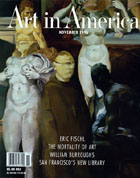
On page 29 of the November 1996 Art in
America, in the "Front Page" news section,
there is an article about the artist J.S.G.
Boggs and his continuing troubles with the
law. Boggs makes, as the article explains,
artworks that "closely resemble U.S.
currency" and that he sometimes uses in
performances where he exchanges them for
goods or services just as if they were
money. He has attracted the interest of the
U.S. Secret Service. Agents raided his
Pittsburgh studio in 1992 and seized over
1,000 personal items, including artworks,
which they refuse to return even though
they have never arrested or charged the
artist with counterfeiting.
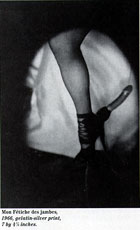
There is something kind of kinky on page
51, a two-page article about a French
photographer and painter named Pierre
Molinier. In a piece that includes a
graphic description of the artist's
suicide, Therese Lichtenstein explains that
Molinier, born in 1900, was a painter who
counted Andre Breton among his fans, and
that he turned to photographic self-
portraiture near the end of his life. "From
the mid-1960s to the early `70s, he made
hundreds of postcard-size black-and-white
prints depicting himself" in photos which
were "mostly transvestite images of the
artist posed partially clad in black
fishnet and silk stockings, sleek stiletto
heels, leather corsets, elaborate
masks...veils, gloves and wigs."
Lichtenstein says that the pictures "render
precarious and ambiguous the categories of
gender," that Molinier "was clearly in love
with the image of himself as a phallic
woman," and quotes Molinier saying, "Je
suis lesbien." Lichtenstein concludes,
"Molinier's ambiguous images of sexuality
and gender raise still-provocative
questions about the transformative
possibilities of artistic production."
There is a new two-page "Art and
Technology" advertising section on page 62,
with ads taken out by over a dozen art-
Internet companies and gallery software
consultants. An ad for OnLine Gallery says,
"Savvy artists and galleries are currently
using the Internet as an effective, global
advertising, marketing and promotional
tool!"
On page 72 is a four-page article titled
"Ars Moriendi: The Mortality of Art," about
the destruction and deterioration of
artworks. Gary Schwartz's argument is that
what survives from a culture is by no means
the best that it produced, and that the
effort to conserve what remains acts to
"intensify existing class and national
differences in wealth and sophistication,
distort historical relationships, fetishize
art objects and perpetuate the myth of
artistic eternity." Armed with statistics
from art historians about the percentage of
artworks surviving from different cultures,
Schwartz says that less than ten percent of
the art from any remote period still
exists. Writing that "art historians cling
to the consoling notion that time acts as a
sieve, preserving the best," Schwartz says
that whether or not an artwork survives is
the result of luck. He quotes Marcel
Duchamp from a 1968 interview: "I believe
that a picture, a work of art lives and
dies just as we do...that the history of
art is extremely random...I am convinced
that the works on view in museums and those
we consider to be exceptional, do not
represent the finest achievements in the
world...Basically, only the mediocre works
created in the past have survived."
There is a nine-page interview by Frederic
Tuten with the painter Eric Fischl on page
77. Asked how he feels in 1996, Fischl
says, "Painting has been diminished; it
doesn't have the importance culturally that
it does to me. Certainly photography, TV
and films now satisfy the dominant need to
see ourselves and tell our stories, to
delight us and entertain us." Fischl talks
to the interviewer about "the European
sensibility" in painting, saying "they
believe very much in ART," and that "all
their gestures are so refined. There are
some hideous examples of European Abstract
Expressionism, like Georges Matthieu." His
interviewer asks, "What about Tapies?" and
out of nowhere, Fischl lashes out against
one of his American contemporaries: "Julian
Schnabel has made Tapies look like a
genius. Schnabel's work just reeks of art
sensibility. It's all grand gesture, very
thought-out that way. It's very clever, but
in a sense he's just sort of handed back
American painting to Europe. He confirms
what they always believed what art was."
Asked about what he sees young artists
doing, Fischl replies "It would be fine if
you could get rid of the ridiculous idea
that all artists have to be in New York."
He continues, "I don't see, except in a few
cases, a vision. With someone like Matthew
Barney, I think there is a vision. But it
seems to me that the younger generation of
artists are just plugging holes. They are
making the one piece that Vito Acconci
forgot to make, the one painting that Agnes
Martin didn't make. They are taking the one
direction that she didn't go in, and they
go in that direction as far as it goes--
which is usually the length of one show."
The interviewer asks, "Where are we with
painting today, is there any vitality that
you see out there?" Fischl replies,
"Today's painting...is dominated by an
ironic voice or a cynical voice. Most
current art that does have social concerns
is highly politicized and highly critical;
it inserts itself into your life, disrupts
your life, and usually makes you feel like
shit. It's about making you feel bad
without a sense of transcendence."
Sonic Youth guitarist Thurston Moore wrote
the "Real Life Rock Top Ten" in Artforum
for the November 1996 issue. His writing
style is about as far from standard usage
as you'll ever see in this magazine; the
editors let him do whatever he wanted. He
takes his poetic-punk license by using
lowercase i's for the personal pronoun and
lowercasing people's names, plus lots of
wacky abbreviations and misspellings. His
top ten is pretty much all music--bands,
records and a club for noise music in
Japan. No. 4 is the art-musician Glenn
Branca, and it's an especially hard entry
to understand: "Art-school fuck ups were
heading into town with split-media-punk-
nihil energy. Glenn was abuzzzz w/ the
cosmic significance of vito acconci's
glorification installation Seedbed. Video
was a nothing dream and only dan graham
could bodysnatch it. Loft gigs were either
"come fuck with me" or "I love you let's
create a humm blinding headstorm naked."
Glenn licked his guitar fuzzing out of
shit-hot amp ON FILM (theatre of sexed
ghosts (in/deed!))" The last three, nos. 8-
10, aren't about music. Nine and 10 are
about books, and no. 8 is two art shows
about SoHo that he liked, Jeffrey Deitch's
"Shopping," where artists put their art in
stores in the neighborhood, and "2nd and
better, is the fucked show at american fine
arts by AC2K (the artist formerly known as
art club 2000)," which included "a
catalogue of interviews w/ local gallery
owners discussing the current trend of soho
galleries pulling up stakes & movin on up
to chelsea where agnes b don't b." He
writes that the show is "presented in a
cigarette-smoking-intelligentsia way," and
that it "really has nothing to do with
supermodels and by god it fucking works."
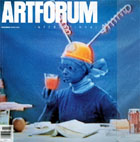
On the cover of Artforum is a picture of
the young British artist Georgina Starr,
made up as a pathetic robot. Inside there
is a four-page article called, "Now You See
it, Now You Don't," about Starr, who was in
the exhibition last year in Minnesota
called "Brilliant" with other young British
artists. This year Starr had a solo show at
Barbara Gladstone, for which she imported a
large camping trailer from England. In an
article full of phrases like "in a Starr-
lit universe" and "something-out-of-nothing
brand of magic," David Frankel says that
"British critics don't seem to know quite
what to make of Hypnodreamdruff, (a four-
part work of videos and installations of
which the camping trailer is a component)
but they do agree on the elaborateness of
the conception." Frankel concludes that
"Starr makes artmaking her subject. And the
artmaking she enacts seems to be one of
makeshift invention, "something out of
nothing," as she has said, using whatever
comes to hand." (Including a caravan?)
Writing that Starr is a victim of "the
contemporary art world's organizational
habit of shipping artists to unfamiliar
cities and asking them to produce, in a few
weeks in situ, a work that will somehow
contribute to residents' understanding of
the place," Frankel says that her solution
is to "combine the baroque and the
spontaneous," to make art using "the
imaginative self's ability to make
something magically complex and layered out
of virtually nothing but its own stuff."
Starr exhibits the sets for her videotapes
alongside the videos themselves, like Paul
McCarthy does, and Frankel identifies what
he calls "a recurrent bodilessness" in her
art; "a feeling of absence: where you sit
and stand, on that bed, on that rug, Starr
herself once played the parts you're
watching on TV, but she's not there
anymore."
On page 83, there is a five-page article
about "Denmark's top filmmaker," Lars von
Trier, by Mark Van de Walle. His movies
sound pretty depressing; Van de Walle says,
"At once coldly formal and just plain
creepy, Von Trier's films are marked by
such generally unfashionable concerns as
moral dilemmas and the role, or lack
thereof, of God in day-to-day life." He
synopsizes von Trier's works, in order: "a
detective flick about a child killer on the
loose; a film within a film centered on
disease and the inability to cure it; a
thriller about post-Nazi German guilt and
doomed innocence; a TV series about a
hospital that's besieged by ghosts and
sinking into a swamp", and most recently a
movie about two people who get married,
where the husband gets injured in an oil
rig accident and "comes home brain damaged
and paralyzed."
Page 87 has Artforum's monthly fashion
feature, "Flash Track," with two fashion
photos on one page, and someone writing
about them on the other. This month they
got some photos that Nan Goldin took for a
Matsuda catalog and Neville Wakefield wrote
the text. Wakefield quotes Nan Goldin
saying that her "aspiration was to be a
fashion photographer," and that she wanted
"to put the queens on the cover of Vogue."
But the pictures here are just of normal
models, "soaked in a soft androgynous
glamour." Artforum seems to be using the
"Flash Track" as a way to get a little
soft-core-whatever into the magazine; this
is the second month in the past three where
they've had a picture of a nearly bare ass.
ArtNet swapped for a quarter-page ad in
Artforum, and the magazine decided to put
it on the very last page of advertisements,
next to one for the Bowery Bar, on page
126.
The November Frieze has a four-page article
by Daniel Birnbaum "on art and the IKEA
spirit" on page 33. Titled "IKEA at the End
of Metaphysics," the article begins with
the impressive facts that "the IKEA
catalogue, with more that 60 million copies
printed annually, is the most widely
circulated publication," and that Ingvar
Kamprad, who founded the company in 1943
when he was 17, is now "officially the
richest Swedish citizen." Birnbaum quotes
Kamprad's book, The Testament of a
Furniture Dealer, which he describes as a
"highly-strung manifesto...a theory of
self-discipline...read by IKEA employees
all over the world." In it, Kamprad writes,
"Let us grow to be a group of constructive
fanatics, who with unwavering obstinacy
refuse to accept the impossible, the
negative. What we want, we can still do.
Together. A glorious future!" Birnbaum says
that "in 1994 it was disclosed that, as a
young man, Kamprad had belonged to an
extreme right-wing group. Even worse, he
had remained a contributor into the `50s.
Although the scandal was widely discussed
in the European and American press, it
seems to have had little, if any, impact on
the company.
The democratic image of IKEA was so secure
that not even aggressive articles
portraying the founder as a full blown Nazi
made much of a difference." Regarding
IKEA's connection with contemporary art,
Birnbaum proposes that "given the
omnipresence of the furniture, it should
come as no surprise that artists working
with ready-made objects often end up using
IKEA." Birnbaum continues, "Two Swedish
pioneers in the field, Anders Widoff and
Stig Sjolund, have long been aware of the
political, not to say metaphysical, power
inherent in the company's products used in
their installations." He does not describe
their work at all, though. He goes on to
name Andrea Zittel, whose mobile furnished
rooms he asserts "could be read as a dark
parody of IKEA," and the Californian artist
Jason Rhoades, in whose "large and messy
installations, the do-it-yourself approach
of the `IKEA world' is combined with sexual
imagery and mystifying autobiographical
material." One recent installation, called
Frigidaire (1996), consisted of
"miscellaneous IKEA products which have
been deconstructed in the most physical
sense of the word, creating a mess in which
every element appears five times--
supposedly a reference to the five IKEA
stores in Rhoades' hometown, post-
historical L.A."
Ronald Jones reports on page 38 that "It is
by now well known that New York's SoHo has
become more heavily populated with chain
stores, furniture showrooms and shoppers
than the city's art world would perhaps
have liked. Many galleries are moving
uptown to avoid the ruckus of unhinged
consumers, the evaporating ambiance of
cutting-edge culture and rising rents." He
goes on to describe two art exhibitions
that address this context; they happen to
be the same two shows that Thurston Moore
listed in his "Top Ten" in Artforum: first,
"Shopping," a large group show curated by
Jerome Sans, which Jones says "is really a
walking tour where...works of art have been
`integrated within SoHo's freshest shops,
businesses, restaurants and boutiques" and
second, the exhibition by AC2K (the artist
formerly known as Art Club 2000). Of that
show, "SoHo So Long," Jones writes, "the
artist collaborative used skills generally
reserved for movie sets, turning the facade
of American Fine Arts into a schizoid
pastiche so in character it was scary.
Soaping the gallery's windows, they placed
a logo for Old Navy, the low-end chain of
the Gap jeans corporation, along with the
date `November 1996.' Running just below
the windows was a long flower box identical
to the one that decorates the Drawing
Center, complete with logo." Jones
concludes, "While AC2K made fun of SoHo's
conquerors, the artists in `Shopping' hoped
to meet their audience halfway, blurring
contemporary art with contemporary
shopping."
On pages 56-57 is a project for Frieze, a
two-page spread called "English Rose" by
Tracey Emin, Georgina Starr and Gillian
Wearing in which the artists swap personas.
Emin plays Starr, Starr plays Wearing, and
Wearing plays Emin, each acting out the
others' art-practice. They parody one
another's work in a storyboard format, made
with video stills and captions. It all
amounts to one giant (but not terribly
funny) inside joke that's totally dependent
on being well-versed in the three artists
work; otherwise the pastiches are just
something really strange.
On page 59 there is a four-page article by
Jon Savage, "Boys Keep Swinging," about
paintings by Elizabeth Peyton of young male
pop-stars. "Elizabeth Peyton's pictures
restate the primacy of androgyny in pop,"
Savage writes, putting forth that in her
"portraits of Johnny Rotten, Sid Vicious,
John Lennon, Kurt Cobain, Liam Gallagher
and Jarvis Cocker, she invites you to look
at these angsty, over-exposed white boys in
a way that is true to their usually hidden
androgynous essence." He says that she is
"an unashamed fan," who "casts an
idiosyncratic, feminine gaze" over her
subjects. The first page of the article is
Peyton's painting of Jarvis Cocker from the
band Pulp, at a press conference, wearing
tinted glasses and smoking a cigarette.
"Propelled to celebrity by his upstaging of
Michael Jackson at the 1996 Brit Awards,
Cocker is a graceful, sharp survivor."
Savage (who is the author of a 1991 book
about the Sex Pistols and punk rock)
devotes a page to "the iconography of the
Sex Pistols," illustrated by two of
Peyton's paintings. The first, Savage says
is a frame from The Great Rock n' Roll
Swindle, where Johnny Rotten "looks at Sid
and cracks open a wide smile." The picture
shows the two, shirtless, Sid Vicious with
a guitar, and Johnny Rotten looking at him.
"Peyton turns this portrait of male bonding
into a picture of two sprites: with their
baby bird hairdos and semi-nudity, dead
ringers for the lost boys in Peter Pan."
The second is a painting of Sid's face,
with bright-red lips, that Savage says
"catches the glee that he felt when he
first joined the Sex Pistols, a curiously
innocent energy that made him the public
face of the group in its terminal phase."
Another painting shows one of the brothers
in the band Oasis kissing the other on the
cheek. Savage: "Peyton is careful to
emphasize male tenderness, beauty, bonding,
as in her picture of Liam Gallagher kissing
Noel." Savage concludes that the condition
of male pop stars, being that they "must
take on androgynous characteristics," is a
result of the "exchange involved in the
postwar, commercial display of masculinity,
where men find themselves the object of the
viewers gaze, a state for which women have
been developing a language for thousands of
years. There is also the nature and volume
of female fandom, to which adequate space
still has to be given: aspiring not - like
the boys--to be the star, but to use the
imagination and construct an ideal out of
the raw materials at hand. Look, they might
say to the local boys, thinking of the
posters on their walls, this is what you
could be and we'd all be a lot happier for
it. The continuing power of this fantasy is
shown by the level of androgyny that
remains in pop."
Patterson Beckwith is an artist who lives
and works in New York.