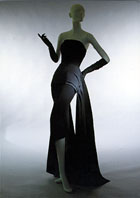
Venus Ball Gown
Embroidered gray silk net
Fall-Winter 1949
dispatches:
dior at the met


by Michael Klein
A stylish Cleveland friend flew into New
York last week. We agreed to meet for
brunch and then pay a visit to the
Metropolitan Museum of Art. Our destination
was the Costume Institute and "Christian
Dior," on view until Mar. 23, 1997.
You will find the Institute in the museum's
north end, past the Egyptian wing, by going
down two flights of stairs. And in honor of
the show, mural size photographs of
mannequins in Dior couture have been hung
to line the walls. Its all a sign of the
elegance and spectacle of the installation
you are about to enter.
Crowded into a maze of display cases are Dior's
slim, angular dresses from the
late `40s cut in gray and blue-gray wool
accented with buttons or fitted with
sculptural cuffs and collars. Further along
is a cluster of black cocktail
dresses -- did Dior invent the little black
dress or did he simply know how do design
them better than anyone else?
There are shirt-waist dresses with full,
wide skirts and long embroidered gowns and
coats and hats and shoes. All the design
here is underscored by the use of a narrow
waist and an elongated silhouette which are
Dior's two true trademarks.
The show surveys works from 1947 through
1957, all documented in a very handsome and
beautifully detailed catalogue written by
Costume Institute curators Richard Martin
and Harold Koda. They examine Dior year by
year, identifying the subtle changes always
at work in his sketches -- one year a tiny,
fitted jacket with a scooped neckline; the
next a dramatic stand up collar; the third
year a strapless gown that gathers in a
giant bow. But the work is consistently the
product of meticulous detail and fine hand
labor.
As you explore the exhibition you come to
realize that the colors, textures and
patterns in this clothing -- his use of
dusty pinks and pale whites -- can be as
subtle as a Watteau or as exotic and
vibrant as a Matisse. It is therefore not
surprising to learn that Dior had been an
art dealer earlier in his career. His sense
of form and line and the ways that cloth reveals
and covers the body is probably drawn from
his lifelong interest in art. In fact,
looking at one of the illustrations in the
catalogue one cannot help but see a
comparison between his 1949 "Cartwheel hat"
and Matisse's elegant portrait The White
Plume (1919).
Of course, you don't need the
comparison to know that art was the
foundation for what he achieved -- having
spent many a night breathing in the
Parisian art world only to later breathe out
tailored garments for the commercial
fashion world both in Europe and the United
States. But there is also a romance in
Dior, a sense of event mixed with costume.
Dior knew well that the matter of dress was
also a matter of protocol, and as an artist
and designer, he also knew that this could
all be dramatically emphasized by a novel
wrapping and a wonderfully imaginative
draping. Like a master sculptor Dior
grasped the mystery of shapes.
Among the day and evening wear one also
finds the costumes of celebrity clients --
Ingrid Bergman, Princess Grace of Monaco
and of course Eva Peron, all of whom used
Dior's talents to dress them for Academy
Award luncheons or state dinners. (Many of
the outfits shown here were donated to the
Costume Institute by the generous Mrs.
Byron C. Foy)
Dior is to fashion as Einstein is to
physics: genius and imagination. And like
Einstein and physics, after Dior the
fashion world was never the same.
Yet Dior's arrival on the fashion scene
after World War II was nothing less than
scandalous -- sculpting in clothes, serving
the rich, ignoring the psychology of the
Ration Card that was still the norm in
postwar Europe. The "New Look," as it was
headlined in the press, angered "les
Parisians" and others whose recently
restored spirits were not quite ready for
this great change. It was all too
indulgent, wasteful, spectacular, feminine
and expensive. But for Christian Dior,
despite the social and economic problems of
the immediate past, the future was now. His
vision represented what was at once modern
and classic, distilling elegance and style
and selling it to the waiting world. His
designs set the pace for fashion and the
fashionable, then and for years to come,
even after his untimely death at the age of
52.
But why such diverse crowds here at such an
exhibition? My Ohio friend and I were
astonished to find long lines throughout
the Institute galleries. Especially for an
exhibition about fashion that is as
individualistic, elite and expensive as
Dior. Its not the "taste du jour" of mass-market
styling as at the Gap, Banana
Republic or J. Crew. Don't we as a culture
relish synthetic fibers and cheap
reproductions? This is high-style, the
construction of unique forms assembled to
create a single image, a great look and to
provide the wearer with the means for a
magnificent entrance.
What does the popularity of this show mean?
Does fashion satisfy our need for instant
gratification, while at the same time it
indulging our fantasy life, making us part
of a select group of shoppers who know what
to wear and where to wear it? Or is it
nostalgia, remembering how Mom and her lady
friends used to dress and how times have
changed? More questions than answers,
really.
Remember Audrey Hepburn in "Charade" or
"Sabrina"? She is the focus of our
attention not only because of the story
line and her own charming presence on the
screen, but because each scene is
choreographed with her particular outfit in
mind. Maybe that's what each of us wants --
at least for 15 minutes -- and that's what
a man like Dior can provide.
MICHAEL KLEIN is a private art dealer and
curator.