| Magazine Home | News | Features | Reviews | Books | People | Horoscope | ||
| Painter's Journal by John Zinsser |
||||
| Obsession drives a lot of good abstract painting, and can manifest itself as all-over patterning, repeated mark-making or rigorous serializing. The fall New York art season kicked off with several strong exhibitions that show the range of this practice.
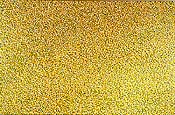
Shirley Goldfarb at Zabriskie Working with a palette knife, Goldfarb built up large-scale field paintings by daubing mosaic-like chips of uninflected oil color. In these works of 1967-1980, the retinal effect is akin to an undulating chromatic net. Like her contemporary Yayoi Kusama, Goldfarb used the painting process as a type of performance. She painted as a means to define her female sexual identity. Now, her work appears prescient and proto-minimalist. Goldfarb's journals are the inspiration for a current monologue-based play being performed in Paris. Some selections from the text include, "Painting my spots? My spots are all I gots" and "When I face that 6 by 10 foot canvas with its spots of color and empty white spaces -- and touch the canvas with a palette knife laden with paint, that is the me I like" and "I worked a bit on my canvas today I worked harder painting my nails and the color of my lips..." and "I am Shirley nobody. I am my own event" (price range: $7,500-$25,000).
Bridget Riley in New York Riley took her cues from London's swinging 1960s fashion sensibility. Her undulating geometries were the hit of MoMA's 1965 "The Responsive Eye" show (soon to be revisited in "Eye Candy" at Ameringer-Howard in New York, Oct. 27-Dec. 2). When the postmodern painter Philip Taaffe seized upon her work as a source for his hip art historical appropriation paintings of the 1980s, Riley's stock rose anew. And now, she's signed onto Pace's power roster. At Pace, Riley's late-career work is being championed as staunch, hard-won abstraction (rare for the fussy, figure-obsessed Brits). Pace's show mixes early gouache studies and recent paintings, so that '60s glamour transforms to market-tested formalism before your very eyes.
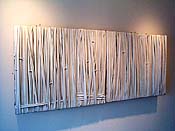
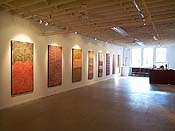
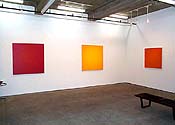
New painting in Chelsea Gavin Brown's Enterprise features the work of young hipster Udomsak Krisanamis (fresh from the SITE Santa Fe and P.S. 1 "Greater New York" circuit). This Thai-born artist's densely collaged surfaces are made from such diverse materials -- strips of paper, marker and noodles on supports of burlap, canvas and cotton fabric. Color is high key, but compressed into micro-flares. Loose grids in dark blues and reds create the impression of stained glass. In the painstakingly impastoed sections, the look is that of a personal cosmology diagrammed, as with Alfred Jenson paintings of the 1960s ($3,500-$16,000). Gregory Coates also pushes his painting surfaces to the extreme. His show, titled "Inspired by Actual Events," inaugurated the new space of Atmosphere Gallery at 134 Tenth Avenue. Coates had a knockout piece at last year's "Passages" show at the Studio Museum in Harlem. It featured rubber bicycle inner tubes wrapped tightly around wooden shipping skids, then painted with powdery blue dry pigment. In it, sculptural materiality gave way to pure color sensation. Now, Coates continues to explore this methodology in a series of compelling wall works. Coates teaches drawing at Cooper Union, and his inner tubes convey the wound-up expressiveness of calligraphic line. In a case of global cross-contextualizing, the Aboriginal paintings of Ronnie Tjampitjinpa at Robert Steele compare nicely with those of the hardcore abstractionists described above. In 1971 the men of Papunya first conceived of presenting their traditional decorated ground sculptures and ceremonial body painting designs as paintings on canvas. Tjampitjinpa (b. 1943), making his U.S. solo debut, carries this idea into territory inspired by Minimalism. His two-color stripe and grid works are refreshingly graphic and clean, while retaining an air of antic singularity. This show marks the debut of a new location for the Aussie Steele's gallery, now at 547 West 27th Street. The gallery building also houses the studios of superstar painters Carroll Dunham and Matthew Ritchie. Also seen: Ruth Pastine's "The Yellow Magenta Paintings" at Margaret Thatcher Projects look monochrome but are not. In each, the colors yellow and magenta have been mixed with each other wet-into-wet. The effect is like wan illumination from an unseen light source. No brushstrokes at all are visible, lest messy gesture interfere with the pure "duochrome" sensation. Numinous, indeed. The Dorsky Gallery, which with its West Broadway location can be counted a "SoHo holdout," does not represent artists. Rather it invites curators to propose exhibits. A nice example of this is "Simply Complex: Monochrome Paintings from L.A.," curated by Reuben M. Baron and Joan Boykoff Baron. It includes Maxwell Hendler, Scot Heywood, Lies Kraal, Marie Rafalko, Roy Thurston and Alan Wayne. What makes West Coast monochrome stand apart from the East Coast school? Mostly attention to "car culture" materials and fetish finishes. The two works by Thurston -- neither fully painting nor architectonic object -- were especially elusive and seductive in this regard. The exhibition is scheduled to travels to the Center for Visual Arts & Culture, University of Connecticut, Storrs; Howard Yezerski Gallery, Boston; and Charlotte Jackson Gallery, Santa Fe.
JOHN ZINSSER is a New York painter and writer. |
||||



©2024 Artnet Worldwide Corporation. All rights reserved.