| Magazine Home | News | Features | Reviews | Books | People | Horoscope | ||
| Weekend Update by Walter Robinson |
||||
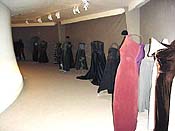
| As everyone must know by now, the Guggenheim Museum is currently filled with clothes by 1980s fashion icon Giorgio Armani, Oct. 20, 2000-Sept. 19, 2001. Art-world purists are hating it as a plunge into kitsch and commercialism. As outreach, the show's a success -- Hollywood celebrities and Fashion District types flocked to the weeklong series of nighttime parties that started Oct. 25.
Art lovers will want to take note of the exhibition design by Robert Wilson, which takes Gugg museum chief Thomas Krens' propensity to mess with Frank Lloyd Wright's classic modernist spiral to an astonishing new level. Using all the artifice of the window-dresser's art, Wilson has turned the ramp into a kind of tunnel of fashion, laying down soft gray carpeting on the terrazzo floors, closing off Wright's trademark bays completely and stretching translucent scrim all along the balcony from railing to ceiling, blocking the famous views across the rotunda. The dresses and suits stretch out in almost endless procession, grouped by color and style and displayed on "invisible" mannequins so that they stand there in their purity, the clothes hollow but erect, a shaped shell on an absent body. The fashion itself looks pretty good, as far as that goes -- gilded and tailored and bejeweled. Is there any design he didn't do? It's like Sol LeWitt and the stripe! "If there had been people in the clothes," said television guru Douglas Kelley, "I would have thought I was at the most fabulous party ever." In one of the side galleries was displayed "Amazons of the Avant-Garde," the traveling show of works by six Russian Constructivist women artists -- but the museum had stationed guards to prevent any of the Armani army from straying... Meanwhile, Debs & Co. on West 26th Street, the hip dyke crowd that came to see Carrie Moyer's new paintings of "God's Army" -- Pop supergraphics featuring images of Jesus as well as the famous Burmese Htoo Brothers -- marked the event as truly chic and hot, too. Her paintings are done in bright primary colors, with the occasional appliquéd marijuana patch or draped plastic lei, and have titles like Helter-Skelter Yantra and Brain Box. They feel adolescent, revolutionary, intense -- and at $1,400 for a 24 by 20 inch painting, are great bargains. Larger works, ca. 70 by 80 in., are $5,500. Is it me, or is there more warm sentiment in new art today? Zoe Leonard's installation at Paula Cooper Gallery wasn't warm, exactly, but it captured the kind of bittersweet melancholy that makes heartbreak so tender. Along the wall in the entrance foyer opposite the desk is a stack of 75 suitcases, motley and battered and redolent of nostalgia and longing (price: $30,000). In the front gallery is a group of new color photographs of signs and shop windows from the Lower East Side, a place that however newly chic still has, as shown in these simple images, a visual culture that's folkish and homemade ($4,000 each in an edition of six). Inside, in Paula's grand wood-beam-vaulted space, is Mouth open, teeth showing (2000), a collection of 162 well-used dolls positioned to stand in a grid on the floor. The Surrealists liked dolls for their gothic character (as do contemporary horror movies), and Mike Kelley uses soiled ones to express a kind of violated innocence. Here, they're all girl dolls -- it's that female tribe again. Leonard's installation suggests a multitude of individual subjects, all children sweet and dear. Is she an expressionist? "I'm still just playing with dolls," she said. More innocence is on display at Sean Mellyn's show of paintings and sculpture at the newly rechristened Jack Tilton/Anna Kustera Gallery on Greene Street in SoHo. Mellyn's forte had been modestly sized, hyper-realist paintings of children that often had a mild Twin Peaks oddity to them -- two kids wearing paper-bag masks, for instance. He also liked to attach things to his pictures, such as building a sculptural nose onto a picture of a kid's face. The new work is large -- from four by five feet to six by nine -- and immaculately painted. He's still immersed in a children's world, making big portraits of kids with exquisite expressions and beautiful eyes. Crème Brulee shows a girl with a Dr. Seuss hair-do and a light-hearted moue. Huevo Ranchero depicts a girl with Pippi Longstocking braids and hazel eyes. In It's a Beautiful Day, a cavalcade of 29 pastel-colored papier-mâché fantasy objects -- walking houses, bunny rabbits, wagons, etc. -- stream from the forehead of a gleeful boy. In the back is a giant sculpture of a bird's nest with three eggs in the fork of a tree trunk. The works range in price from $5,000 to $30,000. More family life at Feigen Contemporary on West 20th Street, where Chicago artist Tony Tasset has a collection of stuff -- DVDs of himself morphing from thin to fat and back, a photo of his mom and dad, another photo called The Eye that is presumably a big blow-up of his young son's eye, and still another life-size photo showing his sexy wife, the painter Judy Ledgerwood (one of her abstractions is on display downstairs). As for sculpture, Tasset has made a taxidermied dead blue jay, and a life-size model of a cherry tree from his yard done in realistic painted wax. Tasset is the joker who, back in the 1980s, made abstract paintings using commercial paint-chip colors and stretched swatches of fur. This time around, his Duchampian focus on his own biography -- "the self as the ultimate readymade," said Feigen factotum Lance Kinz -- is superseded by -- dare I say it? -- the esthetic interest of the objects themselves. The blue jay can be yours for $5,000 -- it's unique -- while the portrait of Ledgerwood is $9,000 in an edition of three. At Gracie Mansion, people were calling the new paintings by Judy Glantzman "beautiful" and "poignant." Glantzman is de Kooning's East Village heir, making portraits of children and adults in expressive pink and blue brushstrokes. "It'd be okay if they made you cry," said Judy, whose sense of costume always added a lively presence to the E.V. scene. The paintings range in price from $750 for a small seven by five inch work to $12,000 for a large oil.
|
||||




©2024 Artnet Worldwide Corporation. All rights reserved.