| Magazine Home | News | Features | Reviews | Books | People | Horoscope | ||
| London Calling by Ingrid Lunden |
||||
| When the Tate Modern debuted to such fanfare last May, some wondered if the old Tate, now renamed Tate Britain, would still be able to catch anyone's eye.
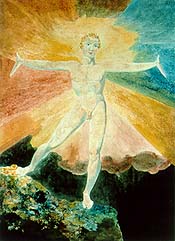
Not to worry. Tate Britain is proving a worthy rival for its sister institution across the Thames. Tate Britain's rehang of its collection -- putting Richard Long rock circles cheek-to-jowl with Claude Monet water lilies, for instance -- is a postmodern fit of inspiration. The museum still hosts the Turner Prize, that annual celebration of new British art that was festively awarded to Wolfgang Tillmans last week. And Tate Britain's exhibition program should banish any notion that British art is stuffy. The current show devoted to William Blake, for instance, is the largest exhibition ever held at the museum and the largest ever devoted to the celebrated mystic. It's nothing if not ambitious. In addition to the mundane work of assembling the hundreds of paintings, drawings, prints and books for the show (which is on view Nov. 9, 2000-Feb. 11, 2001), Tate Britain has even organized two concerts to rouse London's hipsters. On Dec. 1, Patti Smith, unlikely cover girl for the disaffected, performed songs and read poems in St John's Church, where Blake was baptized. At its close, the exhibition culminates with a "monsters of rock"-style concert, called "Tygers of Wrath," in which members of Blur, Jah Wobble, Iain Sinclair, Billy Bragg and other stars will sing Blake's praises. Born in London in 1757, William Blake was a free spirit from the get-go. An opponent of the Enlightenment and its praise for the triumph of reason, and a foe to the precepts of art as taught at the Royal Academy led by Sir Joshua Reynolds, Blake opted for a more Gothic universe grounded in a Christian spirituality enhanced by a vivid imagination. His poetry and his art, which drew on the Bible or works by Shakespeare, Milton and Dante, often used the original stories as inspirations for larger compositions that embodied his own narratives and opinions on good and evil. In his later years, Blake developed a fantastical universe filled with characters of his own creation. Blake had mixed success during his life. Although he did move in more reputable artistic circles, he had only one patron of note, the civil servant Thomas Butts. He had one public exhibition of his art during his lifetime, held at his brother's hosiery shop in 1809. None of the works sold, and the single review of the show described Blake as a "lunatic whose inoffensiveness keeps him from being confined." Yet today, it's easy to see why Blake was so influential. Echoes of his ornate, florid style are evident everywhere, from Art Nouveau to the Pre-Raphaelites, from Surrealism to contemporary painters like Matthew Ritchie, whose parallel universe of characters representing different ideals seems borrowed directly from Blake. The museum has put together an impressive Blake education site at www.tate.org.uk. Unfortunately, however, it passed on the chance to produce an unusual audio guide. Many museum visitors will know Blake foremost as a poet, and it would have been an opportune moment to record long passages of Blake's writings to accompany the display of artful pages from his poetry books, Songs of Experience and Songs of Innocence. Blake surely would rather have wanted viewers immersed in his universe. People will have to wait for Patti Smith and "Tygers of Wrath."
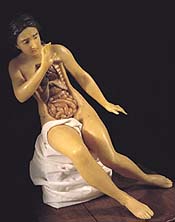
Body of evidence The show includes strangely wooden-looking, 17th-century Dutch group portraits of doctors at anatomy lessons (alongside a more riveting example by Rembrandt). It has rows of opened body parts created in wax. There are skeletons, skeletal illustrations, illustrations of facial expressions and expressively designed operating instruments. One room is dedicated to depictions of pregnant women, complete with open wombs containing removable parts. On view here are the bizarre endeavors of one Dr. Frederik Ruysch, who in the 1600s perfected the process of preserving body parts in display jars, and did just that with a few fetuses, some of which have been adorned with beads. Interestingly, Ruysch fancied himself a bit of an artist and displayed his "cabinet of curiosities" in his house museum. Move over, Damien Hirst! The historical objects are complemented by contemporary works meant solely for artistic consumption -- Beth B, Tony Oursler, Marc Quinn, Bill Viola. Their juxtaposition with the older displays emphasizes the new signification of corporeal knowledge in our age -- a dull feeling of horror hidden within the fascinating, limitless reach of science.
If these walls had eyes... The results come from sophisticated infrared devices used to track viewers' glances. A looking station has been set up in the exhibition, which allows people to participate on the ongoing experiment. Other parts of the exhibition feature a hidden camera set up near the gallery's van Gogh painting of sunflowers, and another provides an audio tour to enlighten viewers on the other ways in which time plays a role in art, both as a theme and as an accelerator of decay.
At the galleries For the last year, fig-1, organized by Mark Francis and Jay Jopling, has been showing an eclectic range of installations -- 50 artists in 50 weeks. As a nonprofit series, it started with almost no marketing budget and has grown almost entirely by word-of-mouth. Info magnate Michael Bloomberg has been sponsoring the show in London, and if he runs for New York mayor perhaps he can be convinced to fund it when the series makes a projected move to the Big Apple. For his part, Francis will stay behind in old Blimey. It seems that his tango with Jay has given the famed curator a taste for art dealing: he has been named the director of exhibitions for the spacious new Anthony d'Offay gallery in the colorfully named Haunches of Venison Yard, down the street from D'Offay's older digs in Dering Street. He takes the post in about six weeks... Tim Hawkinson's first solo exhibition in the U.K. just closed at the White Cube on Duke Street. Known for his gargantuan installations, Hawkinson filled this tiny gallery with new, relatively subdued work. At my visit in late November, two of the five works on display (one record painting and a "skin print") had been sold and the rest were on reserve... Selected works by Prunella Clough are on view at Annely Juda Fine Art until Dec. 16. Little known outside of England, Clough was a leading British abstract painter in the 1940s and '50s. Her works evoke a country in the somber grips of wartime and post-war depression and industrialization. In 1999, Clough was the subject of a popular retrospective at Kettle's Yard in Cambridge and she won the Jerwood Prize for Painting. The recognition almost came too late: Clough was to die on Boxing Day that year.
INGRID LUNDEN is an art writer living in London. |
||||




©2024 Artnet Worldwide Corporation. All rights reserved.