| Magazine Home | News | Features | Reviews | Books | People | Horoscope | ||
| Love Cologne by April Elizabeth Lamm |
||||
|
If Paris is the city of love and Las Vegas is "sin city," then what is Cologne? Something about perfume, I imagine. In search of the answer, I visited the big "Fascination Venus" show at the Wallraf-Richartz-Museum, Oct. 14, 2000-Jan. 7, 2001, and also canvassed the recent Cologne Art Fair, Nov. 5-12, 2000, for "love for sale." After all that, I wouldn't hesitate to call Cologne the second city of love.
For the Old Masters, love was represented by the mythological goddess Venus, whom they depicted almost always completely naked. At the Wallraf-Richartz, all this hot naked love -- 70 paintings, 20 sculptures, 25 drawings and 50 etchings -- was displayed in rooms painted a cool steel blue, as if too much red would have thrown the museum goers into an indecorous tizzy of passion. Selected by a team of curators that included Ursula Weber-Woelk, Claudia Denk, Konrad Renger, Silke Kurth and Andreas Büttner, the Venus show crosses geographic and chronological boundaries, stretching from Sandro Botticelli (1445-1510) to Paul Cézanne (1839-1906). The show subsequently appears at the Alte Pinakothek in Munich, Feb. 1-Apr. 2, 2001, and the Koninklijk Museum voor Schone Kunsten in Antwerp, May 20-Aug. 15, 2001. Sometimes Venus is a creature of the sea, as in Alexandre Cabanal's The Birth of Venus (1863), where she reclines on the crest of a wave, her eyes languishingly opened, hinting to an ecstasy unspeakable. At other times, Venus is portrayed as the lamenting and sorrowful wife of Vulcan, who is shown in Cornelis Cornelisz van Haarlem's Venus and Vulcan (1590) hard at work, perhaps on that magical net in which he would ensnare his unfaithful wife and her lover Adonis, exposing them to the laughter of the gods above. I ventured upstairs to the Ludwig Museum on the qui vive for the love motif in modern art. I found a sensual Hans Arp Female Torso (1953) made of cold marble; an Ernst Ludwig Kirchner undated half-length portrait of a tart revealing her breasts; and Max Beckmann's Pair of Lovers, Green and Yellow (1940-48). Judging by the Ludwig collection, it would seem that the Bauhaus school neglected love altogether in favor of heady composition and color games. None of us today would look at a reclining nude like Goya's Maya Desnudo or Manet's Olympia (or a spread-eagled, found-on-the-internet photograph by Thomas Ruff) and think, oh yes, right, Love. We tend to connect all things fleshy and revealing with the coarse idea of sex as a carnal act of pleasure and sport, whereas Love is the celestial goal post, right? Perhaps Love is better represented through Conceptual Art?
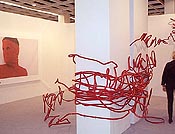
At Art Cologne Take for instance Love Hangover by Jim Lambie, on view at the booth of Glasgow's The Modern Institute, where it was snatched up by a young Berlin dealer for a mite £2,000. Lambie is best known for making stripey floor pieces with colored tape that follows the room's contours, but here, what's a love hangover? A pink leather belt attached to the floor, with its buckle head straining towards the heavens above, much like a charmed Egyptian cobra. I asked Modern Institute co-owner Toby Webster to ask Lambie what he thinks love is (in a nutshell), and he responded (in a nutshell), "Magic." Lambie is also a big fan of the band "Love" from LA. He used to be in a band called "The Boy Hairdressers" himself, whose popularity reached cult status in Japan. Lambie also had another nice piece on view called Radar Love. Attached to a corner of the booth were two black rubber bicycle handles with multi-colored streamers dangling extra-long down to the floor. Just imagining them flying high in the wind from a speedy bike ride conjures up a lot of that high one feels, frisch verliebt -- freshly in love.
Love, New York style When I asked dealer Christian Haye to show me the love he brought to the fair from his Harlem gallery The Project, he cheekily replied, "We forgot the smut!" Then he showed me a lovely series of big black-and-white photographs called "Dreams" by the Argentinian artist Martín Weber. In one photo, a couple sits at neighboring tables in a poor countryside cafe; the man holds up a chalk board on which he scribbled a "dream" of his which reads, "She thinks only of me." In another picture, a man dressed up as Christ in his thorny crown holds up a chalk board reading, "I work for my family." Love's labor lost? In an edition of six, these "Dreams" (1994-98) were selling for $3,600 each.
Love in Hamburg, Paris, Vienna… The music was hopping also over at the Parisian Galerie Emmanuel Perrotin, where Paris's cutest and most loveable gallery assistant -- Adeline -- showed me the photograph of a recling nude by the Lebanese artist Jean-Pierre Khazem. Khazem has his models wear weird masks; his work has also been featured in ads for Levis and Heineken. This big nude, untitled, had me baffled with her ample curves (real) and baby-doll-like face (fake). 16,000 FF would get you one of an edition of 3. For her piece Kiss, the Austrian artist Constanza Ruhm made a virtual building on the computer, and then created a video in which the structure fills slowly with light until it nearly explodes in whiteness. Actually on view in the booth of Kerstin Engholm Galerie is a huge C-print still (260 by 180 cm) from the video -- sort of like the kiss much wished for and never received at the end of a good first date. The implosion of a prude. This Kiss is selling for DM 15,000 in an edition of 3.
Knitting, and Plants The gentlemanly wild man art dealer Franco Noero of Torino showed the work of Henrik Håkansson (b. 1968), a Swedish artist who is currently in residence at the Kunstlerhaus Bethanien in Berlin. For $12,000 you could purchase his sculpture, The Thin Line Between Love and Hate (Only for the Lonely), a group of Tillandsia plants from the island Tobago, where they grow naturally on telephone wires -- exactly Håkansson's cup of tea, nature mixed with technology. Back in 1995 Håkansson held a rave party in a marsh in Sweden for a group of frogs -- documented by the video "Out There Stoned Immaculate" -- who apparently responded well to the beat, croaking in tune." (His Kunsthalle Basel solo show, "Tomorrow and Tonight," was in 1999.) He also organized a concert of 1000 crickets in a piece called The Monsters of Rock Tour. I'm charmed already... Oh, dear, is it love again? And my prince plays with frogs? Ai, Maria, at least I won't have to kiss any more of them!
APRIL ELIZABETH LAMM writes on art in Germany. |
||||




©2024 Artnet Worldwide Corporation. All rights reserved.