Think "wall drawings." Most likely, you think "Sol Lewitt."
Time to think Elizabeth Simonson, whose exuberant wall drawing or, maybe wall sculpture, is one of the most exciting pieces of art this season. Her work can be seen at Plane Space, a new gallery that recently opened in Greenwich Village, in a two-person show with fellow artist Nayia Frangouli.
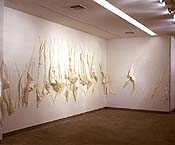
Simonson's Crush is a wall installation made of almost parallel strips of white tape that ripple and slide, slosh and curve across five flat surfaces of the gallery. It looks like the top of a giant wedding cake that's been tipped and is cascading toward the floor. This is one delectable artwork.
Crush was not preplanned. It started with the artist taking rolls of white tape and pasting them in roughly parallel strips across lengths of wall. Picking up subtle downward variations of placement as she moved across the space, she exaggerated them as she moved along, creating three-dimensional ridges, whorls and lashings.
Though process-based, the piece is so sure-footed that it seems like it should have been based on studies, then drawn in space. The gallery's Chad MacDermid told me that this is Simonson's most sculptural work of this type to date. All I can say is that I'm sorry not to have seen the others to have watched her evolving toward this elegant work.
Crush looks super in white, but Simonson has done other similar installations in black tape, too. I'd love to see one of those. Maybe at the Whitney?
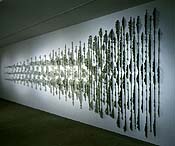
Simonson also showed a wall-filling 3D work made of squarish loops of black tape, called Cryptogram. It's a lovely large Minimalist piece, clearly based on an equation that she developed. A fine workmanlike exercise, it nevertheless lacks the charisma of Crush. Cryptogram is priced $15,000. The cost of installation pieces similar to Crush depends upon size, according to the gallery.
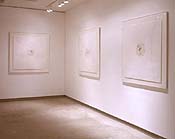
Two ink drawings and an etched monoprint round out her part of this two-person show.
Nayia Frangouli, the other half of the exhibition, is both a photographer and draughtsman. Her straight-forward shot of a structure in Japan works better than the set of four inkjet prints, Untitled (Nihon), double exposures of old and new settings from Japan.
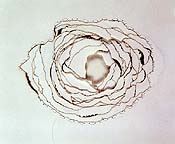
Frangouli's real forte is her three drawings of 30 layers of singed, stitched papers. They seem like sexy blowsy white double-roses at first sight, but intrigue with ethereal underlayers that ghost up, as you look longer at them.
These are captivating works. I wondered what increasing the areas of singeing and intensifying the underlayers might do.
Frangouli also places a collection of laminated dust, dirt, insects and hair in plastic sheets that can be one-on-top-of-the-other. These yielded some interesting combinations of layers, too. Any one of a series of four is $750. The layered drawings are $3,000 each.
Plane Space is located at 102 Charles Street, and is open Wed.-Sat. 10-6 and Sun. 1-5. The exhibition closed on Saturday.
Note: Speaking of Minimalism, that Old Minimalist Master, Sol LeWitt, has a show of handsome, decorative large gouaches at Paula Cooper, 521 West 21st St., through Nov. 30. Two-color, all-over undulating webs, the works are about 60 by 60 in. They cost from $22,000 to $30,000.
* * *
Comic books, one of the influences on contemporary drawing being explored at MOMA QNS at the moment, was also one of the main influences on the style of Lyonel Feininger (1891-1956). A show in the lobby of Deutsche Bank focuses on the artist as he made the transition from cartoonist to painter.
Feininger was born in the New York and had his first success in Germany, where he had traveled to study music at age 16. Instead of becoming a musician, he became a cartoonist for German publications and eventually for the Chicago Tribune. A crucial stage in his development as a modern artist took place on a two-year sojourn in Paris (1905-7) where he saw Cézanne and van Gogh and decided to paint.
He made rapid figure drawings for the next ten years or so that proved to be the basis of many of his later works. Feininger became a member of the Berliner Secession, "The Blue Four," and taught at the Bauhaus in Weimar until it closed in 1932, returning to New York in 1937.
"Lyonel Feininger: Strollers -- The Passing Scene, Early Drawings and Prints, 1906-1912" is a ideal way to become acquainted or reacquainted with his early work. Whether in pencil, colored pencil, crayon, ink, or some combination, rapid strokes often elongate a figure's legs, accentuating movement. The dynamics of a striding man or the way a little girl plays with a toy are dashingly served up.
Perhaps the most outstanding piece in the show is the 1914 ink drawing Eilige Leute (Hurrying People), in which parallel lines establish a ground and vertical lines cross-hatch them to define shapes.
Achim Moeller, a Feininger authority who is currently preparing a catalogue raisonné of the artist's paintings and drawings, organized the exhibition using items that his gallery owns and others that he borrowed. A number of self-portraits bear comparison with the photos of the artist in attractively arranged vitrines. This gives an intimacy to the show. The vitrines also hold important publications plus one hilarious late drawing, proving Feinginger never lost his sense of humor. It's a visually exciting installation that fits beautifully into its surroundings -- not too big, with lots of first-rate pieces. Many are for sale between $5,000 and $100,000.
An informative brochure is available to all visitors.
The exhibition is on view through Dec. 12, 2002, in the lobby of Deutsche Bank at 31 West 52nd Street, daily from 9 a.m. to 7 p.m.
* * *
Want more Feininger? Go uptown to Achim Moeller Fine Art for a show wittily entitled "The Blue Four plus Five." It refers to an exhibition, "The Blue Four," that Galka Schreyer organized to bring Feininger, Paul Klee, Vassily Kandinsky and Alexej von Jawlensky to the attention of the public in New York back in 1924.
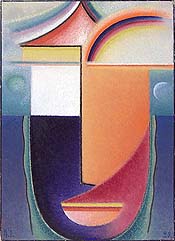
Besides works by these artists, additional pieces by members of Der Blaue Reiter (The Blue Rider), with whom they associated, expand the range of German modernist works on display. There are oils, including the imposing Abstrakter Kopf: Erscheinung (Abstract Head: Apparition) by Jawlensky, sculptures, prints and drawings. A ravishing Emil Nolde watercolor from around 1925, Marschlandschaft (Marsh Landscape) in seductive purples and gold and several Paul Klee watercolors are worth the trip by themselves. Pieces are priced from $50,000 to $1,000,000.
The show is on view through Nov. 23, 2002, at Achim Moeller Fine Art, 167 East 73rd Street.
N. F. KARLINS is a New York critic and art historian.