| Magazine Home | News | Features | Reviews | Books | People | Horoscope | ||
| Gotham Dispatch by Max Henry |
||||
| Inka's inhibitions Some get it sooner, others later. In the case of painter Inka Essenhigh, it's been sooner. In keeping with the impact of high-profile careers flush with newfound fame and $uce$$, Inka has had recent shows at Victoria Miro in London and at the Albright-Knox Art Gallery in upstate N.Y. Now, the fashionably young artist is having her third New York solo show in as many years at Mary Boone on Fifth Avenue. At Boone, Essenhigh has five canvases red dotted and dated from 1999/2000 at $25,000 each. Painted with thick glossy enamel in two tones and monochromes, her finely honed quasi-figures float across an infinite expanse of color field. Nameless and faceless bodices without limbs, they're like armies of castrated corsets bursting at the seams searching for a resting-place. The narratives show sexless mountain climbers, parachutists, construction workers and hang-gliders, floating backpacks and saddles, phallic husks of corn, traffic cones and motorcyclists, mechanistic armatures, see-through sheeting and fencing gear. Her paintings are interchangeable ensembles of humanoids at work or motionless in far-flung environs -- hot pink, peach, turquoise, earthy beige tones, and blood red. It's hard to pin down the works and easy to be seduced by their glassine surfaces. From this point on, the burden falls on Essenhigh to push the envelope further by taking the road less traveled, destroy the image of her Kabuki Surrealist antecedents and remake herself in the image her talent takes her.
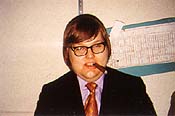
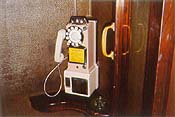
Shore shot In a pleasant surprise, 303 has rectified a wrong by showing Shore as an innovator of color when it was still considered outré. The works are from 1972 to 1993 -- landscapes, portraiture and still lifes that remain fresh and authoritative. One of Shore's axioms is "a photographer solves a picture more than composes one." This is exemplified by the simplicity of his compositions. The alignment of the sight line seems casual and the result of a happy accident, but Shore is very specific about what he documents and how he does it. The front gallery has ten 36 by 45 inch c-prints (in an edition of 8) mounted on aluminum. The pick of this group is Fort Lauderdale Yankee Stadium, Florida, a spring training practice field of the New York Yankees set next to an airstrip with a charter plane, a van and a hangar in the background. A coach and three players are freeze-framed in uniform as they practice the pick-off move to second base. The instant camera look of today is nothing new; Shore did this in March of 1978. In the sky-lit back gallery, Shore has 40 small works, photos made in 1972 that are six by four inches and come in editions of ten. They're Technicolor gems capturing car dealerships and anonymous streets. Some are portraits of colorful characters -- one nattily dressed guy smokes a stogie; would you buy a used car from this guy? An old rotary pay phone reminds you of a bygone era. A pint of milk is bathed in a sea of electric red. Shore has an economy of style utilized to great effect. There's something literary about his distinctly American vocabulary and a personal vision that is a must see for connoisseurs of photography.
Malerie Babylon Marder debuts with "Because I Was Flesh," a new series of untitled color photos. Soft porn title aside, the pictures are film-still vignettes that picture mostly nude couples in anonymous interiors. The "actors" are family and friends posing in stances that convey desire, pensiveness or expectation. The most intriguing of these scenarios are those that pair an older woman with a younger man. In one a young stud is about to exit a shower stall while his matronly lover sits waiting on the bathtub ledge. Another places the couple in a bedroom with the expectant lady undressed, standing hand on hip as she watches her clothed lover who has his back to her. The nubile Marder also includes herself in her work. One photo is a classic nude pose on the beach. Another, perhaps the most intimate of the series, is a bathroom scene with a male lover -- the pair are about to kiss and the sexual tension is palpably heightened by the square shiny red bath tiles. Marder should take the next step and go on to make movies. What jumps out the most is the digitally altered cinematic colors, bright canary yellows and other Blue Movie hues that modulate the tempo of the R-rated mise en scene. In her isolated world, desire is a strange empowerment, flesh the indelible score.
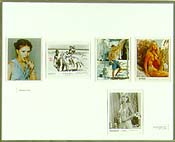
Tricky Dick Prince arranges groupings of autographed 8 by 10 glossy publicity stills and frames them according to genre and type. Buxom playmates are grouped with scantily clad screen sirens, TV action stars are mixed in with movie anti-heroes and rock icons get the shrine treatment. They're signed "To Richard" or "To Richard Prince" in thick black marker and blue felt tip pen. You'd think this guy was a real fan, elevating this cultural melange to the status of Gods. But most are signed by tricky Dick himself and he's pointing out how gullible we are to the cult of celebrity in all of its glorious shallowness. "The image is one thing, the man another story" as Elvis Presley profoundly stated at a 1974 press conference. While Prince has been a postmodern poster boy for his mass media appropriations perhaps it's not a stretch to go back to the famous Paul Gauguin painting, Who Am I, Where Do I Come from, Where Am I Going? Prince reminds us that his dialogue with the masses is still a potent opiate.
MAX HENRY lives in New York. |
||||





©2024 Artnet Worldwide Corporation. All rights reserved.