| Magazine Home | News | Features | Reviews | Books | People | Horoscope | ||
| Gotham Dispatch by Max Henry |
||||
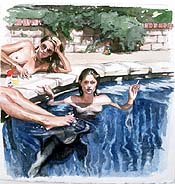
| All the pretty faces Lucky Delia Brown. She and her lacquered L.A.issez-faire friends just can't get enough of themselves. The recent UCLA graduate made something of a splash in "Sentimental Education," a memorably camp group show at Deitch Projects organized last June by Artforum critic David Rimanelli. More recently she had a room all to herself at D'Amelio Terras, the white gallery walls painted a drawing-room grayish-brown color. Lady Delia's first one-person show was called "What, Are You Jealous?" The title refers to the exclusivity of glamorous, velvet-rope, invitation only, VIP parties and the also-rans that can't get in. Brown based this series mostly of modestly sized watercolors on paper on photographs taken at a party she hosted. In early October, Brown was able to parlay this same idea into a pictorial fashion spread of her watercolors (complete with credits to designers for the clothes) in the New York Times Sunday Magazine. The scenarios she draws and paints are a pun on traditional genre art, though her references are to glossy fashion and shelter magazines. Her subjects wear Gucci sunglasses and sip champagne by the poolside with vacant expressions made famous by super-models and their fashion-slave retinues. In one painting two babes who look mildly like porn-movie starlets are lounging by the pool. One is topless with an open magazine in her lap -- this, it turns out, is the artist herself -- while the other twiddles her nose job as she tips her flute of Moêt (we see the open bottle sitting on the pool deck), a decidedly declassé champagne. Cell phone conversations take place while bikini-clad women mingle and gossip. Hotel suites are filled with slouchy prissy males with the air of hustlers and call boys wearing shiny print shirts, women lying around in revealing outfits, their stilettos kicked aside. What could they be talking about but sex and money? The studied casualness of Brown's gorgeous subjects is reminiscent of models turned actors who can't get work, so they stay models. Professional ennui sets in as a Stepford Wives effect takes place, the boy and girl posers in a recurring Bret Easton Ellis Glamorama party scene. Watercolor being the difficult medium it is, Lady Delia does an injustice to her big league drawing skills. Why not show the other side of fashion, the next day? Depressed bourgeois mannequins who share apartments with several friends and have no privacy or intimate space, or the down on his luck dude who uses well-heeled women for his own devices? Where art thou substance, O Delia? This is no critique of the nouveau riche, only a lustful repercussion of new money made too fast too young. This acting out of fabulousness has worn thin on the cognoscenti. True decadence is within the realm of erotica, an esthetic unto itself. True decadence is the domain of Robert Mapplethorpe. What, are you jealous? What, are you kidding?
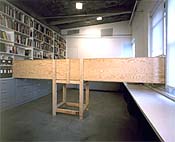
Veritably virtual The title piece, Your Now Is My Surroundings (2000), is an innocuous-looking room built in the center of the gallery. A metal door appears to be an office entrance but instead you walk into a sky-lit rectangular cell. It has a concrete tile floor and mirrored panels around its top half, which creates a sloping, green-tinted illusory space that extends off into the distance. The glass panels of the skylight have been removed, although this is not initially discernable until a minute or so of orientation. This chamber contains no objects, just an interior and unlimited albeit framed airspace. Your Now Is My Surroundings reads like a conundrum wrapped inside of a riddle, with a monastic Zen quality. The ceiling that domes this room appears infinite but in fact is illusory. Perspective is transient in nature, subtly altering across the morning, afternoon and evening. Eliasson is actually enclosing space to conjure the experience of it, thus giving virtual architecture a physical dimension.
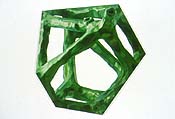
Portals of discovery In this respect he is close to the brilliant artist Matthew Ritchie, (minus Ritchie's superfluous exasperatingly inaccessible intellectual gymnastics). Both are systematic, but Ross is more earthbound compared with Ritchie's cosmology. He's a more, say, muscular painter, with his undulate ground of sky-colored patterns surrounding stacks of stolid Kelly-green boulder shapes and intestinal, aortic forms. Ross also sculpts cell-shaped objects and displays them in glass cases, afterwards transcribing their 3-D effect into his oil paintings. Challenging the conventions of the stretched canvas, he's cut off the corners in some of the paintings (all are untitled), even making a six-sided one. Ross boldly goes where the shapely Ellsworth Kelly has gone before, cutting his own swath while asserting his notion that painting is not flatness, but rather a portal to the unexposed.
Noise They're untitled still lifes of sculptures propelled by an abstract sensibility. The jagged pixilated gestures perhaps riff on Pointillism -- the van Gogh brushwork in one work crescendos and dips like a topological map or satellite photo. He stitches swatches of burlap onto the surface and cuts openings in the canvas sewing open weaves across the holes. Painters don't seem averse to exploiting computer tools for their own devices, and it's notable that Wray's potent canvases make one think of the special effect called "noise" offered on the software Photoshop. Even so, he's a gunslinger, confident in form, willful in intent and daring in execution.
MAX HENRY lives in New York. |
||||





©2024 Artnet Worldwide Corporation. All rights reserved.