| Magazine Home | News | Features | Reviews | Books | People | Horoscope | ||
|
the v&a comes to america
by Mary Anne Hunting
|
||
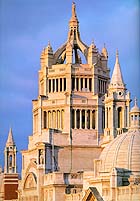 The Dome of the V&A 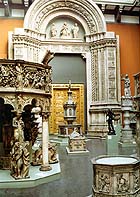 the V&A's east Cast Court  Prometheus Vase 1867  Marquetry cabinet by Henri-Auguste Fourdinois 1861-1867  R.W. Winfield Gas Jet ca. 1848 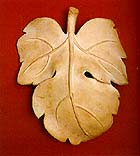 Fig Leaf for "David" ca. 1857  Camille Silvy River Scene 1858 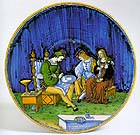 Plate: Majolica Painter at Work ca. 1510  The Holbein Cabinet 1550-80 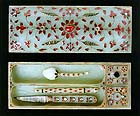 Mughal pen box and utensils early 18th century 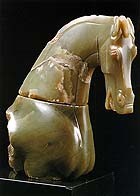 Han dynasty horse 206 B.C.-A.D. 220 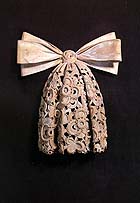 Grinling Gibbons Cravat ca. 1690 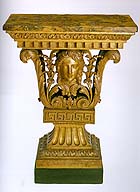 William Kent Console Table ca. 1730  Dante Gabriel Rossetti The Day Dream 1880 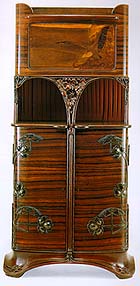 Louis Majorelle Cabinet 1900  Dennis Maclaren Chair ca.1930 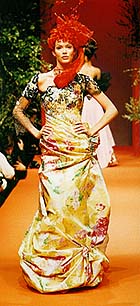 Christian Lacroix Evening dress 1996 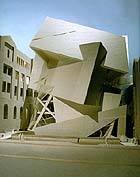 Daniel Libeskind's design for the V&A's Boilerhouse Building 1997 |
If you approach "A Grand Design: The Art of the Victoria and Albert Museum" as a connoisseur in search of masterpieces, you will see only a smidgen of this remarkable exhibition. The 250 objects, primarily decorative arts, also illustrate the fascinating and complex story of London's Victoria and Albert Museum. Established in 1852 to promote good design in response to the esthetic perils of the Industrial Revolution, its ambitions were both grand and novel, and ultimately influential on both sides of the Atlantic.
This is no "once-over lightly" exhibition. But neither is it a blockbuster in which the overriding impression is "too much of a good thing." Rather, "A Grand Design" provides an unequaled opportunity to study a group of stellar artifacts and art works -- scrupulously selected from the museum's more than four million examples -- in relation to their particular artistic, social, political and technological framework. Ideally, visitors should review the 423-page catalogue (Abrams) before viewing the exhibition, but it's probably more realistic to buy the exhibition guide for $3.50 when you arrive, and then take the catalogue home. On view at the Baltimore Museum of Art until Jan. 18, 1998, the traveling exhibition was organized by the Baltimore museum's former director, Arnold Lehman (who recently moved to the Brooklyn Museum of Art) and its deputy director, Brenda Richardson. During the past decade these two industrious individuals convinced the V&A's individual curatorial departments (treating each as if it were an independent museum) to help put such a "Grand" show together. It is not surprising that the Baltimore Museum has great admiration for its fellow institution, for its founding principles were very similar.
The Beginnings: The Great Exhibition of 1851 Cole was a firm believer that a museum is "the only effectual means of educating the adult, who cannot be expected to go to school like the youth." His new museum, Cole said would be "elevated from...a mere unintelligible lounge for idlers into an impressive schoolroom for everyone." Thus, unlike some other art museums of the period, the V&A declared its educational and didactic purposes before the first acquisitions were made. The 13 examples in this first section, called "Industrial Arts and the Exhibition Ideal," are drawn from the Great Exhibition and other such 19th-century shows, and exemplify what were then considered good standards of design. These objects demand to be noticed, if only because of their scale: a 42-inch-wide tortoiseshell tray shaped like Mount Fuji, decorated with lacquerwork and ivory appliqué; a richly embellished painted earthenware vase by Minton & Company, nearly 50 inches tall; and a Staffordshire lead-glazed earthenware vase with transfer-printed decoration, which at 28 inches tall is still considered the largest of its kind. The objects are also recognized for their individual technical genius, one of the most impressive being a French cabinet-on-stand by Henri-Auguste Fourdinois (1830-1907), who used an innovative technique to create the elaborate marquetry. The cabinet won the Grand Prix at the Exposition Universelle in Paris in 1867.
The South Kensington Museums: 1857-1899 But the real crux of the second section is Cole's revolutionary notion that objects could be used to escalate the taste of the general public. Although the study of original works of art was encouraged, Cole felt it was equally permissible to study copies, and to this end he had some extraordinary ones commissioned, utilizing modern technologies such as plaster casting and electrotyping (an electrical equivalent of casting). The electrotype copies of two lions at Rosenborg Castle in Copenhagen, made by Elkington and Co. of Birmingham in about 1885, are among the most impressive of their kind. Although the museum's treasured 18-foot-plaster cast of Michelangelo's David could not travel to America for obvious reasons, its "correctly proportioned" fig leaf did. After Queen Victoria received David as a gift from the grand duke of Tuscany in 1857, the fig leaf was designed to hide the nudity during her visits. It reportedly was in use until 1953. As photography was also considered an innovate instructional tool, the museum's collection was housed in the library for ready access. Not until 1970 did the status of the collection change, and it was moved to the prints department. Many of the museum's photographs were commissioned for documentary purposes, an example being one taken by Charles Thurston Thompson (1816-1868) of the Santiago Cathedral in 1866, when an immense cast of the Spanish cathedral's late 12th-century west portico was being made for the museum's Architectural Court. The museum was also interested in photographs for their technical virtuosity. When Camille Silvy (1834-1910) created River Scene in 1858 it was nearly impossible to record on one plate both the clouds above and the relatively darker landscape beneath, so Silvy made separate negatives for each and carefully printed them on one sheet of paper. While Cole, with the support of Richard Redgrave (1804-1888) who was superintendent of art, steadily kept an eye on collecting for educational purposes, the first curator John Charles Robinson (1824-1913), was inclined towards "collecting for the purpose of hoarding treasures," and by the end of the century, Robinson's vision of a "three-dimensional encyclopedia of connoisseurship proved more attractive than Cole's elusive objective of an accessible pattern book," claims Rafael Cardoso Denis in the catalogue. Nonetheless, even today one can sense the tensions occasioned by these different philosophies.
An Encylopedia of Treasures A number of objects in this section provide insight into the never-ending process of reinterpretation and re-evaluation. For example an oak marquetry cabinet, originally in the collection of the great antiquarian William Beckford (1760-1844) at Fonthill Abbey, was acquired by the museum in 1869, documented as having been "executed from designs of "[Hans] Holbein for King Henry the VIIIth." However, in the 20th century it was established that the cabinet was actually made in South Germany, and the stand, although English, dates from the early 19th century. One reliable museum source reports that this later observation has led some to question the date of the cabinet itself. Similarly, an ebony cabinet-on-stand with gilt-bronze plaques, purchased 20 years ago from the Rothschild collection at Mentmore Towers in Buckinghamshire, has also been re-evaluated. Thought at the time to have been presented to Marie de' Medici in 1600 by the city of Florence and subsequently considered a supreme example of mid-17th-century French court furniture, it has recently been established that this very serious piece of cabinetry was constructed in the 19th century. Many now wonder if other Rothschild furniture forms in European museums were also made later on.
India and the Far East Some of the objects came to the museum via the East India Company, often from officers who pillaged and stole, or from British diplomats. Colonel Charles Seton Guthrie (d. 1874), a wealthy officer of the Bengal Engineers between 1828 and 1857, formed an impressive collection of Mughal Indian hardstones that were among the finest objects from the imperial household, including a dagger and scabbard, a pen box and utensils, and a mirror, all made of jade with rubies. A popular and frequently reproduced object in the Chinese collection is an extraordinary jade head and partial torso of a horse from the Han dynasty (206 B.C.-A.D. 220), the only known jade animal carving of its size. An impressive Japanese hammered-iron incense burner in the shape of an eagle made about 1860 was purchased by the museum from the secretary of the British Legation in Japan for 1,000 pounds, 13 percent of the museum's acquisition funds in 1875. Treasured as a fine example of Japanese contemporary sculpture, it was prominently displayed until about 1910, when it was moved to storage. The eagle has only recently been reappraised.
The English Tradition Exhibition viewers will be pleased to see a number of celebrated images, from the Cathedral from the Bishop's Grounds (1823) by John Constable (1776-1837) and a gilded armchair designed by Robert Adam (1728-1792) and made by Thomas Chippendale (1718-1779), to a gilded console table made by William Kent (1685-1748) for Lord Burlington's Chiswick House, and The Day Dream by Dante Gabriel Rossetti (1828-1882). Another masterpiece, specially cleaned for the exhibition, is a hanging cabinet with richly carved ivory plaques, designed by Horace Walpole (1717-1797) perhaps with Kent. It is fittingly displayed with an early illustration of Walpole's famous Gothic revival house Strawberry Hill, where the cabinet once contained his collection of enamels and miniatures. The jewel of the entire exhibition is a delicately carved limewood cravat made by Grinling Gibbons (1648-1721) and owned by Walpole, who noted in 1769 that he wore it when he received a number of distinguished foreign visitors (Pl. 135). Two exemplary objects designed by William Burges (1827-1881), perhaps the most inventive and exuberant designer of the mid-19th century, are shown side by side: a glass bottle mounted in parcel-gilt silver and various stones; and a painted, stenciled, and gilded cabinet.
The 20th Century At the time, the Brits were still in their "English is best" phase, and when these objects were put on display they were greeted with an avalanche of criticism. They raised such a furor that the museum was forced to issue a "health warning" advising teachers to guard their students against such examples of poor design, construction, and decoration. And as a result, the museum for the most part abandoned collecting 20th-century designs for more than 60 years. An exception was the Circulation Department, established in 1947 to generate educational design exhibitions that would travel throughout Britain. Led by Peter Floud, an active member of the Communist party, with an art school-trained staff, this radical branch of the museum acquired "a great part of the 20th-century collection," claims scholar Christopher Wilk. The Circulation Department was particularly strong in pottery, one of the best examples in this exhibition being a painted stoneware vase called Wheel of Life, made about 1939 by William Staite Murray (1881-1962). Strongly influenced by newly excavated Chinese ceramics, the vase cost some 94 pounds when it was purchased in 1958, a price not paid again for studio pottery until the 1970s. In 1977, under the directorship of Roy Strong, the Circulation Department was shut down due to lack of funds, and the objects were dispersed to the various material-based departments, which were then forced to take 20th-century collecting more seriously. Significantly, such wonderful objects as the exotic glass chair covered with zebra skin (the animal's mane runs down the back of the chair), designed about 1930 by Denham Maclaren (1903-1989) of London (Pl. 179), were acquired during this period.
Contemporary Collecting Despite this tremendous progress, a heated debate rages on about the future of the 20th-century collection: the current Semperian material-based departments can not respond to the range of product designs and new materials constantly being invented by professional designers. As an example, the collection of some 100 radios, many of them plastic, do not fit neatly into the museum's departments. Writes Wilk, "the museum's ability to refer to itself with conviction as a museum of design, to embrace its Victorian roots as well as to re-create itself for a new century, will depend largely upon its grappling with this issue in the years to come." It may not be easy, but it seems to me that the museum will move forward, especially in light of its current project -- a complex and radical deconstructivist building designed by the Berlin architect Daniel Libeskind that will be added to the existing museum complex by the year 2002. Following the Baltimore Museum venue, "A Grand Design" will travel to the Museum of Fine Arts, Boston (Feb. 25-May 17, 1998); the Royal Ontario Museum in Toronto (June 20-Sept. 13, 1998); the Museum of Fine Arts, Houston (Oct. 18, 1998- Jan. 10, 1999); the Fine Arts Museums of San Francisco (Feb. 13-May 9, 1999); and the Victoria and Albert Museum, London (Oct. 14, 1999-Jan. 16, 2000). In conjunction with the traveling exhibition, a symposium entitled "Ideals and Ideology: The Art Museum from 1850 to the Year 2001" will be hosted by the Museum of Fine Arts, Boston, Apr. 23-25, 1998. For advance tickets and information about the Baltimore exhibition call VISTA Ticketing: 1-888-262-4278. MARY ANNE HUNTING is a freelance writer specializing in the decorative arts.
|

©2024 Artnet Worldwide Corporation. All rights reserved.