Rembrandt van Rijn has come to Chicago, bringing old friends along
-- The Three Crosses, The Hundred Guilder Print,
The Goldweighers Field and (of course) Saskia.
Give 30 minutes to Rembrandt, and witness tremendous events and see
envy, pride, cunning, disapproval, love, indifference, lust, and much,
much more.
"Rembrandts Journey: Painter, Draftsman, Etcher," an exhibition of 153 prints, 33 drawings, 20 paintings and seven copper etching plates, is on view at the Art Institute of Chicago, Feb. 14-May 9, 2004. Basically a print show, the exhibition presents printmaking, drawing and painting as intertwined or parallel developments. Rembrandts Journey is roughly chronological, organized around the themes to which the artist returned repeatedly with fresh insights and interpretations: Biblical illustration, portraiture and self-portraiture, daily life, landscape and the nude. We watch Rembrandts narrative and technical achievements advance together.
Storyteller
Like many artists before him, Rembrandt
uses the Bible as a source. Medieval and Renaissance painters attempt
to evoke intense religious feeling, but Rembrandt wants to tell a
convincing story. Even in his grandest scenes, we find people who
are indifferent to the central action, antagonistic, or simply asleep.
Dogs scratch themselves and children play in the Messiahs presence.
Rembrandts people have dumpy bodies and live in decrepit surroundings.
There is little of the heroic in Rembrandt. He speaks to our age.
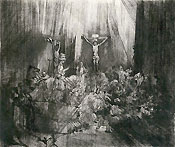
Christ Crucified between the Two Thieves ("The Three Crosses")
depicts one of the most transcendent events in history. We see Christ on the cross
at the center and Roman soldiers, his executioners, just to his left.
Most ride slowly off having finished their days work, but one suddenly
understands who Christ is and kneels in awe at the foot of the cross.
Others departing the scene look like crowds leaving a theater, but
mixed among them are Christs devastated followers. Beneath the cross
to the right are the Virgin Mary, Mary Magdalen and apostles, who
grieve in different ways. They cling to each other, gesture helplessly
and cover their faces to blot out the awful scene. A dog, which understands
only that something is terribly wrong, barks and races off.
We recognize Rembrandts people from our own lives and images weve
seen of wars, floods, fires and other disasters. Times may change
but human nature remains constant, and no other artist is better at
depicting emotion through body language. Rembrandt brings people to
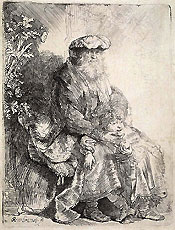
life through his rendering of feet, knees, heads and hands. In
Jacob Caressing Benjamin, for example, the patriarch is quietly
delighted with the little boy who stands between his knees. Holding
a fruit in his hand that he probably wheedled from Jacob, Benjamin
cannot keep still and stands with one foot atop the other as he chatters
happily away. Jacobs hand and Benjamins feet animate this image.
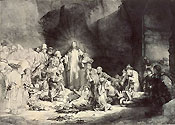
Christ Preaching ("The Hundred Guilder Print") is one of
the great masterpieces of art history. Christ stands somewhat to the
left of center on an elevation with one hand raised in blessing and
the other gesturing. A slow-moving crowd of the lowly and afflicted
enters through a gateway at the right and struggles toward Christ.
One poor wretch is carried in a wheelbarrow and several people have
the vacant look of the starving or very ill. On the left is a much
more prosperous bunch -- a dandified young man whom Christ looks past,
and the Pharisees, Christs enemies, whose feelings range from apathy
to hostility. All of the more than 30 figures in The Hundred
Guilder Print reveals themselves through the way they sit, stand,
and move. Every one is completely human. Every one is completely alive.
Portraits and Landscapes
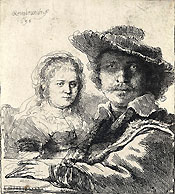
In Self-Portrait with Saskia the handsomely costumed artist
sits at a desk, drawing pencil in hand, looking straight at the viewer.
Saskia, seated behind him and to his left, also gazes out. Solemn
and jowly, Saskia is no beauty, but Rembrandt makes her seem electric
in this and other portraits. She is his wife and we see her as he
does.
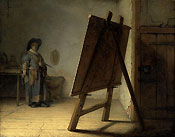
The Artist in His Studio, an early painting, shows an artist
facing the void. A young painter (maybe Rembrandt, maybe not), fully
dressed for a day of work, stands in a shadowy corner of his studio
looking uncertainly at a panel on an easel. Perspective makes the
panel seem larger than the artist and light makes it the paintings
focal point. What is painted on that panel? Only the artist knows
what he will put there.
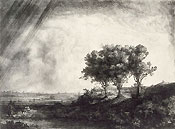
The Landscape with Three Trees probably originated on one
of Rembrandts country jaunts outside of Amsterdam. We see the flat
Dutch landscape beneath a lowering sky, which occupies almost two-thirds
of the image. There is a rain shower at far left, thunderclouds across
the top, and wind bending the trees. The clouds cast a shadow on the
ground, but where they have cleared away, a gray brightness illuminates
the three trees from behind. People are all over this landscape --
a fisherman by the stream, lovers communing in the bushes, and a carriage
in the distance with a man walking behind. Far away we see fields,
houses, a windmill and church towers. To make this print, Rembrandt
combined etching, drypoint and engraving. He learned each technique
separately and then found ways to employ them together.
"Rembrandts Journey" will probably be down before most people read this. It was shown earlier at the Museum of Fine Arts, Boston. Fortunately, Clifford S. Ackley, who organized the exhibition, has written (with others) a most excellent catalogue, which describes each work in detail and describes the artists technique. Its not very often that we read a book of 300-plus pages without finding a single superfluous word, phrase out of place, or imprecision of any kind. Excellent as it is, Ackleys catalogue only serves to bring us closer to Rembrandt, whose art will speak as long as there is a human race.